It
seems incredible that this attractive, accessible and vividly
graphic music has escaped the recording studio until now. Another
feather, then, in the cap of SOMM, the independent record company,
that continues to grow in value and importance.
George
Dyson’s one movement choral work, St Paul’s Voyage to Melita,
first performed at Hereford Cathedral on 7th September
1933, is a setting of words from Chapter 27 of the Acts of the
Apostles telling the story of St Paul’s journey to Rome up to
the point where he is shipwrecked on the island of Malta.
The
text gives Dyson every opportunity for tone painting vibrant seascapes.
From the opening imposing declamatory brass chords underlining
the introductory choral recitative, the narrative moves forward
to the voyage ‘in the lee of Crete’ where the ship is becalmed.
Dyson, with eerily pitched high woodwinds, brilliantly suggests
the doldrums, of burning sun beating upon glassy glinting waters,
sails hanging desultorily. Then comes the Euroclydon, the tempestuous
wind that tosses the ship violently. The storm music is a ferocious
crescendo all lashing gales and high waters crashing. Impressive
as this music is, the text’s complexity (including references
to making the ship ready and concern about quicksands) is perhaps
not as expressively rich as one might have hoped. The highlight
of the composition comes with the moment of stillness at the centre
of this storm when Dyson magically depicts St Paul’s vision of
the angel of God. Against a gentle, persistent timpani ostinato,
a beautiful, rapt liturgical theme on stings and high woodwinds
gently underlines the tenor’s revelation. The work concludes with
a celebration of landfall and deliverance with bells chiming over
a heavy bass evocation of dangerous depths escaped. As Lewis Foreman
in his excellent notes observes the 1933 audience might well have
been familiar with Stanford’s evocations (Songs of the Sea
and Songs of the Fleet) and probably Vaughan Williams’s
A Sea Symphony, still at that time establishing
itself and Bridge’s The Sea and Bax’s Tintagel would
have been thought of as being very modern. While Dyson’s music
recalls aspects of these – particularly A Sea Symphony
– this music has a definite individual stamp. Handley draws an
inspiring and spectacular performance that grips from start to
finish and Neil Mackie, wonderfully expressive with a keen insight
into shape and line in this work and, especially, in the Quo
Vadis Nocturne, is an authoritative St Paul.
The
hauntingly lovely Nocturne from Dyson’s Quo Vadis is an
amalgam of verses by Robert Herrick and Isaac Williams. Here the
singer who cannot sleep, counts every leaden minute, his weariness
and solitude eloquently accompanied by the viola and gentle pianissimo
organ tones. A hushed chorus with soft organ peddle and harp salutes
the dawn as the tenor intones "sweet spirit comfort me"
at the Nocturne’s magical close. The clarity of Mackie’s delivery
is exemplarory. This recording was originally issued by Unicorn-Kanchana
in 1988.
Agincourt,
given an exciting lusty performance here, was written for
the jubilee of the Petersfield Music Festival in 1956, some twelve
years after Walton’s celebrated Henry V film score. It
comes as something of a shock after being so used to Laurence
Olivier’s lusty declamation of ‘This day is called the feast of
Crispian…’ to hear Dyson giving these famous lines to a gently
reflective women’s chorus even if the continuing lines, ‘This
story shall the good man teach his son, And Crispian shall ne’er
go by from this day to the end of the world but we shall be remembered;
we few, we happy few…’ become a muscular men’s chorus. More conventionally,
‘Now all the youth of England are on fire… is delivered in high
elation, all eagerness to set out to war in supreme confidence
but with the women’s chorus more gently lilting in ‘convey you
safe, and bring you back charming the narrow seas to give you
safe passage ...’ Finzi and Elgar are recalled in the patriotic
‘Suppose you have seen the well appointed king at Hampton pier…’
followed by thrilling sea music as ‘the Armada draws ‘through
the furrowed sea, breasting the lofty surge’, music very reminiscent
of Vaughan Williams’ A Sea Symphony. Another fine piece
of tone painting comes with the depiction of the English and French
camps the night before the battle. Soft recessed drum taps and
distant but approaching chorus and orchestra suggest a neutral
perspective between the combatants, a master touch. Dyson’s Agincourt
ends with a stirring setting of the Hymn after Agincourt
(1415).
Handley
and his Bournemouth forces excel in this accessible, vividly evocative,
programme music. How has this wonderful music escaped the recording
studio until now?
Ian
Lace
see
also review by Rob
Barnett
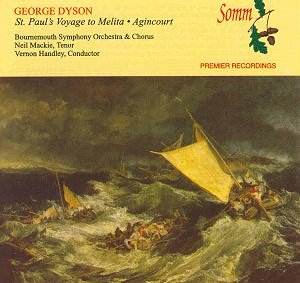
 Neil Mackie (ten)