This
is an unexpected and probably unique coupling, but a glance at
the dates shows just how logical it actually is. Not only were
the composers roughly contemporary – allowing for Tchaikovsky’s
lamentably early demise – but the two concertos date from the
same year. Saint-Saëns was French by birth, but his music
is closer to Liszt than it is to his contemporary Bizet, or to
later French composers such as Ravel or Debussy. The French sensibility
is very different from the Russian, however, and this disc provides
us with the intriguing possibility of comparing the two.
Given
decent performances this would be reason enough to recommend this
disc. In fact both performances are sensational and merit the
highest recommendation.
The
fourth of Saint-Saëns’ five piano concertos opens with a
hesitant little theme which quite clearly comes from the same
pen as the well known "Organ" symphony of eleven years
later. Both the piano writing and especially the constantly evolving
transformation of thematic material are reminiscent of Liszt,
even if the demonic side of that composer is largely absent in
favour of a certain aloof elegance. A slower section in this first
movement is based on a beautiful and tranquil theme which is transformed
with great ingenuity and much originality in piano and orchestral
writing. Both the theme and the way the composer deals with it
again recall the Third Symphony, and there is even, in some of
the piano writing towards the peaceful close, an echo of Rachmaninov.
The second movement is in three sections, the first lively, the
second short and slower with a cadenza, passing without a break
to the rousing final section based on a tune you’ll be whistling
for the rest of the day and which, in line with the composer’s
practice, grows out of previously presented material.
Collectors
who have been following here the reviews of Joyce Hatto’s ongoing
concerto and solo recital series on Concert Artist (and hopefully
buying the discs afterwards) will know what to expect. Her playing
in this concerto by Saint-Saëns is of the utmost technical
assurance allied to great musicality and integrity. Nothing is
done for effect, and when the playing is exciting for the listener,
and it frequently is, the excitement seems to stem naturally from
the music in a most uncanny way. The orchestral playing is superb,
the brass section wonderfully sonorous at one point, and René
Köhler, as ever in this series of discs, is a most able and
attentive accompanist.
I
can’t think of a better way to get to know the Saint-Saëns
concerto, and if that weren’t enough it is coupled with one of
the most compelling Tchaikovsky firsts I’ve ever heard. This is
a reading which takes no prisoners, and the listener either submits
to it or runs away. Have the soloist’s opening chords ever sounded
quite so massive as they do here? And just listen to her extraordinarily
arresting way with the immediate restatement of the opening theme
and subsequent short cadenza! One of the hallmarks of Joyce Hatto’s
playing in general is fidelity to the score, yet she is not afraid
to go against the composer’s markings when it suits her. Thus
the first subject proper, though it fully respects the composer’s
asked for allegro con spirito, it is hardly piano,
but any criticism tends to be silenced by the remarkable conviction
of the playing. This is very muscular Tchaikovsky, passionate
but never over-inflated and without the slightest trace of bombast.
Some might find it relentless, but it demands to be heard. The
pages leading to the main first movement cadenza, which is itself
played at white heat, are astonishing. A couple more piano
markings are ignored as the team fires its way to the end of the
movement, and indeed dynamic markings in general, in the orchestra
too, are turned up a notch for much of the time, but this is all
of a piece with the reading of this movement as a colossal struggle,
drama, tragedy, where any respite is cruelly curtailed. In this
view the soloist and conductor are totally at one.
The
second movement comes as the greatest possible contrast after
this, perhaps a little slow for an andantino, but again
the listener has the feeling that interpretative decisions have
been taken for purely musical reasons and not, as is too often
the case in this above all concertos, for the aggrandisement of
the players. So perfectly blended are the two cellos in the famous
restatement of the main theme that we might think there is only
one of them playing, and is there any other reading of this work
which better respects the tempo indication of the faster section,
prestissimo, or more fully demonstrates that the title
of the folk song on which it is based is Il faut s’amuser,
danser et rire?
The
reading of the finale is as gripping as that of the opening movement.
Listening first without a score I was surprised by the number
of tempo changes, but in fact they are all marked and observed
by these players. Listen, for example, to the second subject,
relaxed in tempo when first announced by the violins, but suddenly
faster when taken over by the soloist. I’ve never heard it done
quite this way, but it’s what the composer asks for.
I
actually wouldn’t want to hear Tchaikovsky 1 like this every time
– it’s too exhausting for one thing – and both Argerich (with
Abbado) and Richter in his famous recording with Karajan offer
a calmer evening, strange though it may seem. But Joyce Hatto’s
tumultuous reading should be in every collection.
William
Hedley
MusicWeb
can offer the complete
Concert Artist catalogue
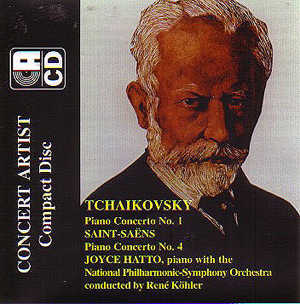
 Joyce Hatto, piano