I
reviewed
the Op.39 Études-Tableaux in an alternative
coupling on CACD 9218-2 harnessed to Hatto’s powerful performance
of the Second Concerto. They have now been detached
and reissued coupled with the Op.33 set to form a logical group.
I’ll reprise my remarks concerning the later set and add my views
on the former, which are quite consonant. Those admirable qualities
that proved so stimulating and convincing in Op.39 are equally
so here. In the F minor Op.33/1 her control of rhythm is admirable,
the relaxation acutely judged, the drive one of purpose, surety
and digital command. There is great nobility and naturalness of
phrasing in the second of the set, a flowing ease and in the Grave
No.3 she charts its rise and fall with chordal space; one listens
in admiration at the way both hands draw out melody lines, evoking
with clarity the melancholy lyricism at the heart of it. Hatto
has a knack for characterisation and this is best exemplified
by the way she brings out the almost avuncular sturdiness of the
D minor and the whimsical directness of the E flat minor to which
in particular she adduces drama and treble runs, charting a sure
course for its mock serious conclusion. Her tone is rounded, unselfconscious
in its application. There’s real bounce in the E flat major, a
perfectly weighted rhythmic fleetness with martial left hand and
a real command of the miniature tone poem life of the Etude. Equally
there are some bewitching sonorities in the G minor; here Hatto
reveals herself a master of Rachmaninov’s syntax and of its colouristic
potential, etching its communing romanticism and unease with distilling
understanding and generosity. In the C sharp minor there is power
and great grandeur of utterance, hieratic, solemn, the left hand
lines never generically subservient, always audible and pointing
the rhythm.
When
I reviewed the Op.39 set coupled with the Concerto I listened
to Kissin’s recording, which similarly coupled them – though he
doesn’t play 3, 7 and 8. I listened for points of comparison and
distinctive individuality between the young lion, Kissin, and
the pianist who first came to prominence in the 1950s. How telling
the vision and sensitivity of the older musician, how fallible
and heedlessly impetuous the young lion sounds measured against
her. In every case Hatto emerges not simply triumphant but magisterial.
Her conception, her sound world, her sense of narrative and her
powerful individuality are components of a wholeness of understanding
of these works. The opening C minor shows the disjunctions between
them – he is a touch steely and hard, clearly taking more obviously
to heart the injunction Allegro agitato. Hatto is notably
quicker, more decisive; more mature both architecturally and tonally.
One can hardly deny Kissin his superbly weighted tone in the A
minor [no. 2] – it’s truly marvellous but equally it’s put to
the service of a rather etiolated tempo and Kissin’s directional
sense never matches his tonal beauty. As a result he emerges rather
directionless, both melodically and harmonically. Hatto’s greater
speed is accompanied by what it’s best to characterise as a vertical
sense – harmonic and lyric. Maybe she can’t match Kissin at some
moments for sheer concentrated beauty of tone but the music makes
infinitely more narrative sense in her hands. She drives powerfully
through the F sharp minor Tableau without ever losing rhythmic
control and without pressing too viscerally hard. In the B minor
[No. 4] which Rachmaninov said was to do with a Fair scene, one
can admire Kissin’s golden halo of sound – but also note that
it blunts the energy and decisiveness of the music. But both he
and Hatto are good here at the joviality and teem of the music.
In the Appassionato of No. 5 in E flat minor she is again quicker,
more glinting and also more inward with great weight of left hand
tone through which she never forces. She is not as obviously romanticised
as Kissin but our narrative-pictorial sense is far more vividly
engaged by her performance. And so with the Little Red Riding
Hood allegro of No. 6; Kissin is malign and theatrical with powerful
ascents and climaxes and his dynamics are powerful. She’s actually
far, far wittier (his rather wintry sense of humour is seldom
indulged) and impish and actually more tempestuous – also incidentally
warmer and considerably more imaginative. She has the wisdom and
maturity to know how this Tableau works, as Kissin does not. The
lento seventh coalesces pictorial elements with absolute seamlessness
and drive and the Allegro moderato [the Eighth in D minor] has
rhythmic power in profusion but observes that moderato direction
acutely. The lyric curve is never compromised in this excellent
performance. She brings a wonderful and enlivening sense of colour
and controlled animation to the last Tableau – the chordal flourishes
especially. At the same basic tempo as Kissin she manages to etch
things more sharply, to conjure a greater sense of meaning – in
short to play with a greater ranger of nuance and understanding.
Once
more this is a splendid achievement; clarity and emotive commitment
are the hallmarks of Hatto’s credentials. She is simply not to
be found wanting in this repertoire.
Jonathan
Woolf
MusicWeb
can offer the complete
Concert Artist catalogue
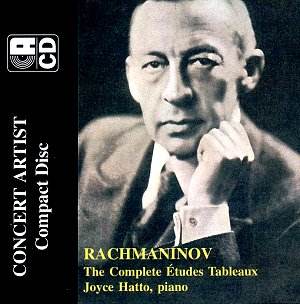
 Joyce Hatto (piano)