These
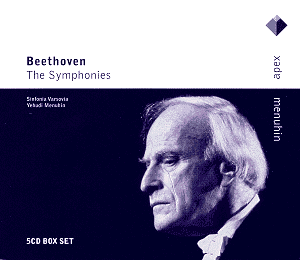
CDs contain recordings of live performances of the complete Beethoven
symphonies which Menuhin gave with the Polish chamber orchestra
Sinfonia Varsovia in Strasbourg in the summer of 1994. The set
really is great value at around £20 for the 5 discs, though
you will have to put up with introductory applause and a certain
amount of ‘ambient noise’ from the audience – very little, though;
Strasbourgers (if they call themselves such) in June seem to be
blessedly free of chest ailments! The performances fizz with life,
yet have few of the rough edges and other deficiencies that one
sometimes finds in recordings of live concerts. There are occasional
uncomfortable moments – a tentative, half-fluffed oboe entry in
the Andante of no.1, a little untidiness in the first movement
exposition of the Pastoral, some less than ideally beautiful
clarinet tone in the Adagio of no.9. But these are small
things, and the playing of the Sinfonia Varsovia is generally
of an extremely high standard.
The
performances themselves have been meticulously prepared by Menuhin
and his musicians. There is nothing routine here, and, though
the great man’s view of the music could, I suppose, be described
as relatively ‘traditional’, yet there is a constant awareness
of his lively, searching musical mind re-discovering the music.
As you might expect, he is particularly alert to the possibilities
of string textures, often the accompanying tremolando or repeated
notes in the inner parts, which can so easily be ignored or thought
of as ‘padding’. To give just one example, the stormy passage
that disrupts the serenity of the glorious Adagio of Symphony
no.4 (CD 4, track 3, after 4:30) is driven by repeated semiquavers
in the strings, which Menuhin gets his players to push hard right
up to the sudden diminuendo. It’s small touches like this – of
which there are many – that bring the often familiar textures
of this music brilliantly to life.
Tempi,
too, are interesting. They tend to be on the brisk side, sometimes
quite surprisingly so. The first movement of the Eroica
moves along with great gusto, and this symphony benefits as a
whole from Menuhin’s energetic projection. I far prefer his treatment
to the broader approach on show when, for example, Barenboim brought
his East/West Divan Orchestra to the Proms recently (though there
was plenty to admire on that wonderful occasion). The finale of
the Choral has an equal dynamism, Menuhin pressing the
music forward urgently. Even the final tender choral repetition
of the word ‘Elysium’ is not allowed to hold up the headlong career
of the music up to the final bar.
The
lighter symphonies – 1,2 , 4 and 8 – get wonderfully sparkling
performances, full of fun and humour. OK, the finale of the 4th
is marked Allegro moderato, instead of which we get a hectic
moto perpetuo. But if it’s the spirit that matters more
than the letter, then Menuhin has got his priorities 100% right.
And, despite its general good humour, the first movement of Symphony
no.8 is allowed to build considerable tension as the climax of
the development is reached. Another interesting aspect of Menuhin’s
concept of these works arises at this point too. The ’cellos,
basses and bassoons announce the recapitulation of the first theme,
and orchestral balance is a notoriously tricky issue here (CD4,
track 6 after 5:30). Beethoven doesn’t help by marking the whole
orchestra fff, one of the very rare occasions on which
he used this dynamic. Most conductors get the other instruments
to play softer so that the theme can be heard. But Menuhin’s instinct
is not to adjust balance in this way, rather to present the music
‘warts and all’ as it were. There are other moments when Beethoven’s
judgement may not have been spot on (though it could have at least
something to do with the heavier sound of modern instruments),
notably in the first movements of the Choral and Eroica,
and again, Menuhin plays them as they are. This is
an honest, not an insensitive, approach which I understand and
applaud. And there are plenty of other instances where details
not always easily caught come over clear as a bell.
The
only movement where I wasn’t convinced by Menuhin’s approach was
the first of the Fifth. His article on this supremely famous work
(well the first five bars anyway) in the accompanying booklet
is mainly concerned with issues of phrasing, and very interesting
it is. However, that wasn’t the issue for me. Instead of the usual
emphatic, detached playing of the three quavers in the famous
opening phrase, Menuhin asks his string players to keep their
bows on the string, resulting in a very different, smoother
sound from that which we are used to. That in itself is of course
no bad thing, but … I remain to be convinced by the result!
Menuhin
includes all repeats in these performances, which, given the quality
of the music-making, is a great commendation. It not only means
that we get some substantial chunks of music that we don’t usually
hear (e.g. the ‘first-time bar’ in the exposition of the Eroica,
often omitted), but restores the correct proportions to movements
that are often unintentionally stunted. Oddly enough, it’s the
finales that benefit most, in particular those of the 7th
and 8th symphonies, both of which have huge codas.
These second development sections, which is what they effectively
are, can seem over-extended, but with the repeat of the movements’
expositions, they fall into place perfectly.
The
recordings are excellent, though the finale of the 9th
is the least satisfactory – it sounds a bit cramped, as though
the microphones were placed a little too close to the vocal soloists.
But generally the sound is clear, well-balanced and atmospheric,
and, as mentioned above, largely unspoilt by audience noise These
bargain discs are another wonderful tribute to one of the most
thoughtful and sensitive musicians of the 20th century.
Gwyn
Parry-Jones
 Jean Glennon, soprano, Dalia
Schaeter, contralto, Algirdas Janutas, tenor, Benno Schollum, bass
Jean Glennon, soprano, Dalia
Schaeter, contralto, Algirdas Janutas, tenor, Benno Schollum, bass