Hashimoto
Qunihico ‘studied with Egon Wellesz in Vienna in the first half
of the twentieth century and associated with Alois Hába
and Ernst Krenek, before meeting Schoenberg in Los Angeles when
he was returning to Japan,’ according to Naxos’s blurb on the
back cover of this disc. All the ingredients either for a stylistic
mess, or an inspired synthesis, therefore. In the event, the truth
is somewhere in between, but veering towards the latter.
Hashimoto’s
First Symphony was composed in honour of the 2600th
anniversary of the foundation of Japan and dates from 1940 (Richard
Strauss’ Festmusik zur Feier des 2600 jährigen Bestehens
des Kaiserreiches Japan, Ibert’s Ouverture de Fête,
Pizzetti’s Symphony in A and Britten’s Sinfonia da Requiem
were all commissioned for the occasion. In the event, though,
the Britten was deemed unsuitable.)
Hashimoto’s
is a rewarding work. The composer’s particular brand of delicacy
informs the perfumed opening. During the course of the movement,
one is aware of the diversities present in this piece: around
five minutes in, the music becomes shamelessly Romantic, yet around
9’20 there is a marching band (Hashimoto uses the ‘March of the
Children’). One almost expects a second one to approach from the
distance, playing another tune in a different key, à la
Charles Ives. The orchestral ‘dissolve’ which closes this movement
is beautifully managed here.
The
second movement, based on Okinawan material, contains clear folk
references. It is sweet and well constructed, although the Copland-ish
feel around 2’40 comes as something of a surprise! (some later
passages even have a pastoral English feel to them …). But the
delicacy is sheer delight. The work closes with Theme, eight Variations
and a Fugue with a combined total of around twenty minutes. The
theme is known as ‘Kigensetsu’, described in the notes as, ‘virtually
a second National anthem sung on 11th February each
year by the whole nation and therefore the most suitable for celebrating
the 2600th year of the Emperor’. Certainly it undergoes
lush treatment here, and Hashimoto’s variations are skilfully
done. Structurally, the fugue might on paper make for a difficult
mix, but Hashimoto achieves his goal convincingly.
The
Symphonic Suite from the ballet, Heavenly Maiden and Fisherman
(Hashimoto’s fourth ballet score and written before he left for
Europe) acts as a substantial filler. It is a piece in which Japanese
melody intermingles with references to Dukas and Pierné.
There is a certain ritualistic side to the Introduction that leads
in to and prepares for the implied yet understated monumentalism
of ‘Dawn’. It is the Near East that is evoked in the Scheherazade-like
‘Fishermen’s Dance’. A pity that soloists are uncredited, as there
is a lovely bassoon solo in ‘The Fisherman’s Solo Dance’ and a
sweet-toned violin solo in ‘The Heavenly Maiden’s Dance’. The
bright scoring of the final ‘The Heavenly Maiden’s Ascent to Heaven’
is entirely appropriate.
Performances
are as dedicated as one would expect from a Japanese orchestra
propagating its own music. Recording is of the highest quality
(engineering is in the safe hands of Tony Faulkner, I see). All
of which adds up to an entirely recommendable product that should
not fail to delight.
Colin
Clarke
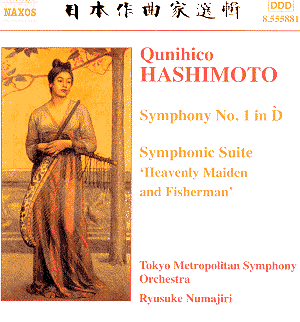
 Tokyo Metropolitan Symphony
Orchestra/Rysuke Numajiri.
Tokyo Metropolitan Symphony
Orchestra/Rysuke Numajiri.