Of late we have had the opportunity to listen
to Merlin, Albéniz’s 1906 opera that has only recently
had its first fully staged performance (2003) at Teatro Real in
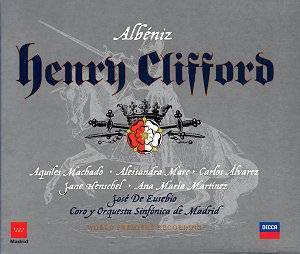
Madrid. Now Decca gives us Henry Clifford, his earlier, first
grand opera and one can now trace the composer’s operatic lineage
even further back, to the start of his artistic collaboration
with his librettist, Francis Burdett Money-Coutts, the aptly named
millionaire banker. The theme is the War of the Roses, the plot
appositely convoluted, whether warlike, confrontational, love-lorn
or verdant; the libretto frankly tosh of the most delirious kind,
and the greatest focus of interest is Albéniz’s orchestration,
which is particularly intriguing in its compound of late nineteenth
century and Wagnerian generic theatricality. One simply wouldn’t
know that it was written by him and in the context of an English
language libretto, listening blind, I would have hazarded a guess
at a German educated British aspirant to the domestic operatic
crown.
Albéniz was a London resident in the last
decade of the nineteenth century and his benefactor was determined
to establish English opera based on the Wagnerian model. The first
two Acts embody many set numbers and though the notes state, correctly,
that the third Act is more through composed there’s very little
effective distinction to be made. There are colourful roles and
plenty of opportunities for declamatory, histrionic and sensitive
singing. As I said the orchestral writing was, for me, the most
telling part of the work – the orchestral bridge passages in particular
are frequently deeply impressive – but set pieces abound and despite
the work’s deficiencies it gave me great pleasure listening to
it, cavils aside. One of those cavils I suppose we should note
here. Most of the cast are Spanish and I rather pitied their vocal
coach. The libretto is so besotted with plighted troth
and Away! Black beldame (it’s impossible to overstate how
truly appalling it is) that many of the singers, not unsurprisingly,
have some difficulty in pronunciation. Allied to which the sonic
sound stage is sometimes a bit skewed; some singers are more forward
in the balance than others. It would also be true to say that
the men have more comprehensively satisfying roles than the women
and that both are sometimes taxed by some strong demands on their
upper registers. This doesn’t sound like an easy sing and the
cast cope relatively well, though not comprehensively so.
There are a number of points of interest in the
score right from the colourful and dramatic late Romanticism of
the prelude, with its powerful strings and the medievalism of
the woodwinds. I said that there were no clues as to the composer’s
identity but maybe there’s just a slight prefigurement in Henry’s
aria and the duet with Lady Clifford O Mother why didst thy
deny my longing for the fray. And Albéniz really shines
in the Act I sequence following So am I quite unknown?
where the orchestration is marvellously expressive, central
European, with burnished horns and Wagnerian moulding. There are
certainly foursquare moments in Act I. The defeated Messenger’s
cry All is lost! ushers in a solidly blustery but unsatisfactory
few pages that only returns to form with the bier processional
tread announcing the death of Clifford’s father; noble and fine.
Again the inconsequentiality of the libretto and the uncommitted
hesitancy of the score lead to a rather lame conclusion to the
act.
The second Act opens in fairyland with some Mendelssohnian
material and is suffused in ballet generosity but before long
we get the heft of a love duet between Henry and Annie which brings
out some passionate singing though in truth the second Act is
no advance on the first and treads dramatic water for much of
its length. What stays in the mind is something like the scene
setting orchestral passage announcing the Earl of Richmond’s landing
or the stirring Shall loyalty to phantom right in the final
Act and Albéniz’s thoroughly professional approach to dramatic
highlighting.
So I wouldn’t rate this as a success in the same
way that Merlin was, but I would say that in its embryonic way
it sheds new light on Albéniz’s earlier compositional life.
To this end the booklet is extremely helpful, noting the historical
context, the textual problems and the production history. And
on a personal note, for all my strictures, I enjoyed it.
Jonathan Woolf
see also review by Lewis
Foreman
 Escolanía
de la Santa Cruz del Valle de los Caídos
Escolanía
de la Santa Cruz del Valle de los Caídos