For biographical background on the English composer
John Williamson please refer to earlier reviews on this site.
The Song of Nature is from An
English Suite reflecting the elation experienced while cycling
through a country landscape. This particular piece is somewhere
between Debussy and late Frank Bridge.
These coordinates also encompass the Fifth
Set of Palindromic Preludes and the Seven Interval
Studies. Not only is the idiom surprisingly uniform across
these pieces but Williamson's delight in the palindrome avoids
the stultification that such contrived structures can engender.
The Sixth Prelude is in much the same mood as the Song of Nature.
The explosive Eighth may well remind you of the sonorously echoing
bell towers of Bax's First Piano Sonata while Prelude 11 recalls
the Rachmaninov Etudes-Tableaux. The Seven Studies were
premiered by Murray McLachlan at Chethams on 31 August 2002. The
music reminds me of Howells’ for solo piano in its reach towards
an almost Oriental world as in No. 3. The Fourth and Sixth are
also potently lyrical in Williamson's now accustomed pastoral
vein. These pieces are well worth sharing if you have already
come to terms with John Foulds' superb Essays in the Modes.
The set ends with the virtuosic headlong hurtle of 'Fast-Dramatic’.
The Piano Sonata No. 4 The Palindromic
is not a strict palindrome but we are told that its melodic
and harmonic structures follow that pattern. Such technical niceties
are almost an irrelevance to the general listener who will find
this work to be in an approachable idiom related to Prokofiev
and also to the more imperious and darker John Ireland (as in
the Ballade and Sonatina). After a lullaby-slow
Pastorale comes an alla scherzo of sweepingly chilly
arpeggiation and a caustic, angular and grim finale. One gets
a strong sense of cohesion and structure from this music.
The disc ends with the brief but telling Lament
for Sarah played by the composer. The other tracks are
spell-bindingly played by Murray McLachlan.
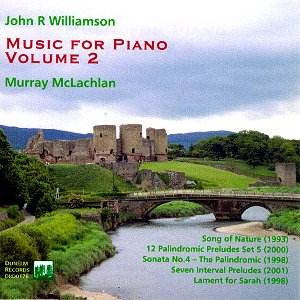
Congratulations to Dunelm on an attractive yet
functional design for the cover of the CD booklet. The liner notes
are by the composer.
Rob Barnett
Hubert Culot has also listened to this disc
Throughout his composing career, John R. Williamson
has patiently and painstakingly developed his own formal thinking,
mostly based on palindromic structures. Many of his pieces clearly
reflect this life-long concern. He has composed six sets of Twelve
Palindromic Preludes as well as a number of works, such
as the Second and Fourth Piano Sonatas, that also often rely on
palindromic structures, harmonic, rhythmic and melodic as well.
I once read a remark that any fool can write a palindrome. It
nevertheless it is much more difficult to compose a palindrome
that also makes sense, musically speaking. Williamson is clearly
such a composer, for his beautifully crafted, wholly idiomatic
pieces may be fully enjoyed as pure, abstract music of great expressive
appeal. DUNELM RECORDS’ previous release devoted to Williamson’s
piano music (DRD 0134) already demonstrated the composer’s full
mastery of his aims and means. The present release, actually Volume
2, confirms the impressions gathered from the preceding disc.
The Fourth Piano Sonata is a substantial work
in four movements, including a beautifully expressive slow movement
framed by lively, rhythmically alert outer movements. The fifth
set of Twelve Palindromic Preludes completed in
2000 consists of neatly characterised movements, in turn energetic
and contemplative, serious and playful, in which Williamson’s
masterly is evident throughout. One completely forgets his formal
concern with palindromic structures and one simply enjoys some
beautiful piano music. This, I think, bears ample proof of the
measure of assurance and command achieved by the composer in his
handling of the material. Seven Interval Preludes,
dating from 2001 and first performed by Murray McLachlan in August
2002, have of course much in common with the earlier works represented
here. The studies are again very contrasted in mood, and the whole
set ends with a brilliant Toccata.
This magnificent release opens and ends with
two short pieces. Song of Nature, an atmospheric
Pastorale, is actually the fourth section of An English
Suite whereas the last item, played by the composer, Lament
for Sarah is an excerpt from a set of variations for harp.
This short, but deeply-moving miniature "reflects the sadness
following the death of a granddaughter in 1998".
Those who have heard the first volume previously
released by DUNELM will know what to expect. To those new to Williamson’s
music I will only say this: If you respond to piano music by,
say, Debussy, Ravel or John Ireland, you cannot but respond to
Williamson’s idiomatic, often impressionistic, expressive music.
Murray McLachlan plays beautifully throughout and is obviously
much in empathy with the music. His magnificent readings, carefully
prepared and tonally varied, serve the music in the best possible
way. I simply hope that DUNELM will go on recording Williamson’s
music and that further instalments will soon be available. Warmly
recommended.
Hubert Culot
See also review
by Ian Milnes
Letter from the composer
Dear Rob
I felt that I just had to write
and express my gratitude to you on the most eloquent and discerning
review of my 12 Housman Songs Disc. You have indeed reflected
a sincere insight into my particular and, if I may say so, my
very personal compulsion towards Housman's unique poetical messages.
You seem to be the first critic who has uncovered my personal
obsession with Housman so accurately. Actually, when I came across
Housman's poems in the 80s, I had no idea that he was already
so prolifically set by a host of others. I was so drawn to the
opposites of pastoral beauty and the irony of man's destruction,
the obsession with death, it all seemed to reflect the tragedies
of my own life. You certainly saw through me. I became immediately
a member of the Housman Society. I have been performed by a few
baritones, but several of high repute have not shown a preference
for my work.
To fill in some your unknowns
about me, I am in my early 70s and have set about 90 of Housman's
poems, outstripping all other composers in this field, being about
two thirds of his total output. I may say also, after some criticism
of my songs by the renowned baritone Stephen Varcoe, that I have
revised a great deal of the piano parts in the 12 songs on the
disc, which I now consider to be inferior to my revisions. I intend
to produce a 2nd. disc of Housman in the near future.
Thank you again for your astonishing perception
of my work.
With kindest regards,
John R. Williamson, b. 1929
MORE WILLIAMSON CDs
Twelve Housman Songs (Nigel Shaw/composer) DUNELM DRD0133
Music for Piano - Volume 1 (Murray McLachlan) DUNELM DRD0134
Music for Organ - includes Williamson's Organ Sonata DUNELM DRD0178
 Murray McLachlan (except
last item which is played by composer)
Murray McLachlan (except
last item which is played by composer)