AVAILABILITY
www.symposiumrecords.co.uk
From the death of Maud Powell in 1919 to the
rise of the young Menuhin the leading American violinist was courtly
Albert Spalding. Though he had faced domestic competition in the
early days from such as Francis Macmillen and from the slightly
younger Auer pupil, Eddie Brown, to name but two, it was Spalding
by virtue of his consistently impressive concerto and sonata performances
who lasted the pace. Later the émigré Russians and
Europeans took an increasingly large share of popularity and esteem
but Spalding still managed to retain an important place in American
musical sympathies and his selfless and patriotic behaviour in
both world wars endeared him to many, no less than his cast iron
sense of responsibility and duty in musical spheres (witness his
noble, last minute salvaging of the premiere of the Barber Concerto
for one).
Spalding recorded heavily for Edison and Brunswick
and after the Second War for Remington. But some of his best recordings
were made for Victor and it’s to these that Symposium has turned
in this compilation, a nicely balanced set of two sonatas and
two concerti. It’s a notably well-chosen selection because the
Spohr and Sinfonia Concertante are two of Spalding’s finest recordings,
the Tartini showcases his impressive classicist credentials and
the Mozart has, so far as I’m aware, never been re-released in
any form since its 78 issue. The Sinfonia Concertante with Primrose
was the second recording of the work after Sammons, Tertis and
Harty in 1933. We can really appreciate the elegance, precision
and stylistic acumen of Spalding here. He had a famously electric
trill, fully in evidence, and behind him there’s a degree of orchestral
clarity, if not always tidiness In the Andante one can hear the
great classicist Spalding’s clarity of articulation and tonal
shading. There is much distinguished playing from both soloists
though arguably nothing quite so deeply moving as that achieved
in their different way by Sammons and Tertis. In the buoyant finale
Spalding and Primrose observe the stylistic niceties rather better
than Sammons and Tertis whose massive rallentando will not be
to all tastes and it is interesting to hear Spalding very slightly
lengthen his note values. This is a fine recording and it is unarguably
the case that this is the finest of Primrose’s recordings of the
Concertante – his recording with Heifetz was an unseemly dash
and that with Stern and Casals a turgid wallow. The Sinfonia Concertante
has certainly made appearances on CD; I’ve reviewed a Pearl disc
under William Primrose’s name but the Symposium is by far the
better transfer, the Pearl being afflicted by constant scratch.
The Spohr was recorded by Heifetz and Kulenkampff
as well as by Spalding but it’s the American’s traversal that
has always seemed the most impressively generous in toto. Forthright
and eloquent, expressive and firmly focused he spins a most persuasive
line, his pellucid tone taking on ever more weight of vibrato
usage in the slow movement. His expressive swellings never break
emotive limits and the vibrant playing of the finale’s fugal passage
and his succulent little finger intensifications illuminate and
irradiate the finale; he’s excellent in alt as well. Collectors
should know that the Spohr is contained on Biddulph 054 but, again,
I prefer the Symposium transfer. The sound is more open here and
there was a slight gauze over the Biddulph, which certainly didn’t
reflect the excellence of the original recording.
The Tartini is a locus classicus of his very
classical instincts and Spalding was invariably at his best in
such works. His fast vibrato, concentrated core tone and buoyant
expressive musicality are all on show, as are his prominent portamanti
and no nonsense sense of direction (not for him Váša Příhoda’s
romanticised intimacies in this work). A Classical Record ACR
42 was devoted to Spalding and contained as well as the Tartini,
sonatas by Handel (No 6), Franck and Brahms’ No 2. There’s slightly
more surface noise on Symposium’s transfer of the Tartini
but also a mite more presence as well. Spalding admirers, needless
to say, will nevertheless find ARC42 a mandatory purchase for
those hard-to-find sonata recordings. So to the Mozart Sonata,
again with his long-standing sonata accompanist André Benoist.
(It’s a mark of both Spalding and Benoist’s cultural sophistication
that both wrote fine autobiographies; Spalding’s contains a magnetically
intimate analysis of what a soloist feels as he is about to embark
on the opening broken octave entry of the Beethoven Concerto).
They catch the wit, the litheness and affecting lyricism at the
Sonata’s heart with unforced simplicity.
The notes are by Tully Potter and they are rightly
admiring of Spalding as a man, though maybe implying his, in the
end, lesser standing in the great ranking list of violinists.
Maybe so, but this is a portrait of a serious and generous musician
"in the round" and I found it an admirable tribute to
a distinguished musician.
Jonathan Woolf
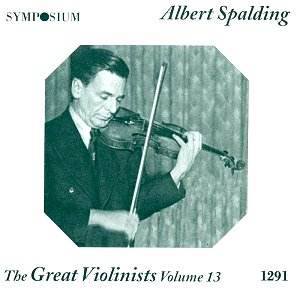
 Albert Spalding (violin)
with
Albert Spalding (violin)
with