AVAILABILITY
www.calarecords,com
In my book you can never have too many Stokowski-Scheherazades.
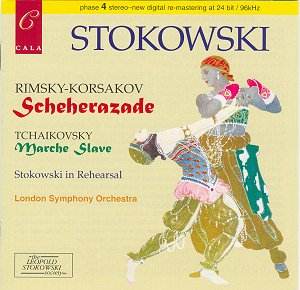
This one, the famous - the infamous – Phase 4 LSO recording of
1964 has been remastered to ever more spectacular effect and now
joins the serried ranks of the two Philadelphia (1927 and 1934),
the Philharmonia in 1951 (currently on Testament) and the late
RPO recording of 1975 (I won’t clog up the review with details
of the isolated movements Stokowski recorded between 1919 and
1927).
The 20 channel system had its enthusiastic adherents,
many American and Japanese; the wide separation with microphones
on top of the instruments created a sound perspective of astounding
immediacy, truly, as claimed, a sonic spectacular. There was greater
resistance in Britain where Phase 4 had something of a chequered
history - certainly in critical terms – and many preferred Stokowski’s
last traversal of Scheherazade with the RPO (again with Erich
Gruenberg as the seductive solo violinist) for precisely those
reasons of mellowness of perspective and a natural sounding balance
even if there were some problematical areas of interpretation.
Nevertheless one remains amazed by the sound of the Phase 4 recording
in all its flamboyance and glamour. The string entries are massive
boulders of sound and the trumpets’ blistering glare is enough
the strip wallpaper at twenty yards. To all this in The Sea
and Sinbad’s Ship Stokowski encourages a gorgeous cellistic
cantilena, strong on sob and feeling. Proof of the immediacy of
the mike placements comes in the harp passages – as, later the
triangle and cymbals - where they leap out at one explosively.
Interpretatively one can admire the rubati of the wind principals
and the dainty clip Stokowski encourages in the strings’ phrasing,
idiosyncratic and personalised and exciting. There’s plenty of
lyricism and swing in the third movement with some truly gorgeous
violin tone and the finale is intensely evocative and powerful
- trumpets are thrilling and the strings’ sheen almost luminous.
There are of course a fair number of Stokowskisms, which you will
either appreciate or reject, but the central consideration will
be the recording.
The rehearsals for the recording were also taped
and we have here twenty-one minutes or so. They show, as expected,
a master psychologist at work. He begins by attending to balance
problems, adding that he wants a good recording not a "mechanical"
one. He is a crisp rehearser, brisk with recording engineers,
after so many years knowing precisely what he wants. As for the
so-called Polish accent, well he sounds precisely what he was
- an English born musician who had spent many years in America.
He has some amusing things to say about tea breaks but shows his
canny side with the words "splendid, wonderful, but a few
things we can make better" which he then proceeds to do,
admonishing the players for practising when they should be listening
to him and making patching as easy as possible for himself, the
players and the engineers. His humour is also in evidence, especially
when he chides the players for not playing with passion, wondering
aloud whether they ever get excited.
His 90th birthday was celebrated with
a concert at the Royal Albert Hall, from which comes a kaleidoscopic
performance of Marche Slave complete with off mike introduction
from conductor to adoring audience. There’s a fine booklet note,
as ever with Cala.
Jonathan Woolf
 London Symphony Orchestra