Let me make it clear; this disc is not a barrel of
laughs. Shostakovich’s Chamber Symphony is an arrangement for
string orchestra of one of his bleakest and most harrowing works, the
Eighth Quartet, while pretty well all of Alfred Schnittke’s music is
… well, bleak.
Oddly, however, bleak is not the same as depressing,
even though, according to his son Maxim, Shostakovich was in a state
of near suicidal depression when he composed the original quartet. This
is an extraordinarily rich piece, marking as it does the extension of
the self-referential process started most notably in the Tenth Symphony.
Here you will find quotations from the First Symphony, the Piano Trio
and the opera Lady Macbeth of Mtsensk among others, while the
D-S-C-H motif, the composer’s musical ‘signature’, is heard immediately
at the outset (he uses German notation to ‘spell’ this, so that the
notes work out as D-Eb-C-B in our notation) and permeates most of the
work. The symphony rises from a grief-stricken opening movement, through
the desperation of the Allegro molto, followed by the sardonic
waltz of the third. The fourth movement is the crux of the work, occupying
a similar position to the bassoon-led recitative in the Ninth Symphony.
Barely audible sustained notes act as a static background to harsh down-bowed
chords, which return menacingly despite various melodic explorations.
The finale, unlike the Ninth Symphony’s, offers no escape from this
confrontation, returning instead to the darkness from which the work
sprung.
Barshai’s transcription is masterly, losing little
of the intimacy of the original, and gaining much in power and impact.
The Moscow Chamber Orchestra play superbly, and with an instinctive
comprehension. This is not surprising as Barshai was their conductor
when he made the transcription, and they gave the first performance.
The conductor, American Constantine Orbelian, is the
soloist in the Schnittke concerto that follows. This was new to me,
and I found it a fascinating work; as a composer, he was a master of
transformation, often from the familiar to the strange. Listen to how
he sets up a simple broken chord pattern, superficially reminiscent
of the Moonlight Sonata, and gradually disfigures it. (Track
6, 2:05). Deliciously macabre! Sometimes, such passages are made more
unsettling still by the use of microtonal glissandi in the strings (track
6, 5:30). In certain respects, this concerto has much in common with
Chamber Symphony, for both works are essentially cyclic in structure.
Here, the oppressive opening is succeeded by an urgent Allegro,
more conventional in style, followed by a sinister gallumphing waltz
(track 8, 0:00), which in turn dissolves into the powerfully dramatic
cadenza for the soloist. Then, after a short interlude, there is a gradual
return to the uneasy calm of the opening music.
Two uncompromising masterpieces, each one moving and
intensely satisfying in its way, despite the prevailing sense of despair.
The performances are pretty much ideal; Orbelian is as compelling a
piano soloist in the Schnittke as he is a conductor in the Shostakovich,
and the MCO plays with total commitment, as well as imagination and
technical mastery. The recording captures it all effortlessly, with
perfect balancing of the various elements. An outstanding issue.
Gwyn Parry-Jones
see also review
by Colin Clarke
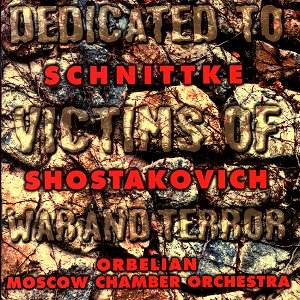
 Moscow Chamber Orchestra/Constantine
Orbelian (pianist and conductor)
Moscow Chamber Orchestra/Constantine
Orbelian (pianist and conductor)