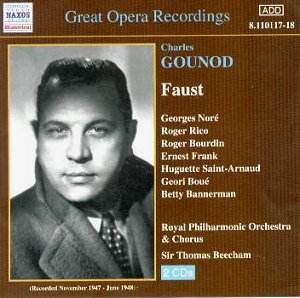
Beecham had recorded an English language Faust
in 1929 with a cast led by Heddle Nash (available on Dutton). Nearly
twenty years later there came the opportunity to record with an almost
all French cast (the sole exception was the fine mezzo Betty Bannerman)
and his new Royal Philharmonic Orchestra. On thirty-two sides and not
released until 1949 the set cost £6.18.0 – no mean financial undertaking
in austerity Britain.
The first and perhaps most resonantly striking feature
of the recording is the cultivated surety of the orchestral playing.
Beecham sets his stamp on the Introduction to Act I with some glorious
phraseology, the strings – well drilled but pliantly expressive – contouring
their line with finesse and freshness. To this the famous RPO winds
respond with rich character. Indeed throughout the entire recording
the orchestral playing is unflaggingly excellent and of notable sonority.
The cast is fine. No one scales the heights - no one plumbs the depth.
Stylistically all is well. But it would be wrong to suggest that in
this manifestation at least the great pre-War French school had survived
intact. The main point is that they are idiomatic, that they make a
convincing cast, which they do – but again in terms of vocal heft, in
convincing theatricality they are somewhat lightweight. Yes, Georges
Noré makes an ardent Faust if one markedly youthful in
years – he doesn’t even attempt to mask his relative youth through some
Gerontion impersonation. He has pliancy and vigour and power when called
for (and he can float a head voice with commendable accuracy and duration)
though maybe doubters will point to a certain lack of tonal variation.
Roger Rico is Mephistopheles – splendid voice, sure instincts but inclined
sometimes to underplay the more saturnine aspects of his role. Roger
Bourdin as Valentin lives up to his reputation though maybe strains
at the top; the once exotically hyphenated Geori Boué is Marguerite
and an actress par excellence who puts great expressive meaning into
her voice without sacrificing pitch, tone or line. She is technically
secure, adept but again – these are quibbles but it’s true of the cast
in general – in the final resort lacks real beauty of tone. The compensations
are significant but I think the charge still stands. The smaller roles
are well taken; Ernest Frank, Huguette Saint-Arnaud and Bannerman.
Technically the recording is good though several moments
of intractably askew balance (choral mainly though not exclusively)
have proved impossible to rectify on this excellent transfer. The Chorus
is on potent form and it’s not their fault in the Church Scene if they
were strongly over recorded in the first place. So whilst there is a
qualified welcome for the performance – the cast simply is not on the
same level of vocal eloquence as other more obviously famous ones –
there are no complaints on its very welcome restoration to the catalogue.
It’s no one’s first choice Faust but it’s a cohesive and stylish
performance irradiated by the orchestra’s excellence and Beecham’s panache
and sensitivity.
Jonathan Woolf
 Georges Noré
(tenor) - Faust
Georges Noré
(tenor) - Faust