Isaac Stern once had a poor rehearsal of the Beethoven
Concerto with the RPO conducted by Beecham. Going to apologise the conductor
patted him aside and said things would be better in the following morning’s
rehearsal. Come the morning and the violinist was handed a meticulously
marked score. Beecham had been up into the small hours noting points
to the librarian to mark. Stern played the rehearsal magnificently and
remembered the incident for the rest of his life – one of the highlights
he said of his career. Which might seem odd, when one considers Beecham’s
reputation for slovenly indifference and the sometimes-fashionable opinion
of him as incapable of handling symphonic super-structures.
No sign of that here. In the case of the Sibelius he
was, Stokowski’s then-unissued slightly earlier recording notwithstanding,
a discographic pioneer. His recording with Heifetz, a scintillating
collaboration and easily the greatest of their not untroubled recordings,
remains devastating to this day. This later 1951 traversal with a very
different violinist is on a lower level of engagement. Though he was
to re-record it in 1969 with Ormandy and the Philadelphia I’m not convinced
it was Stern’s kind of work. Some of the syntax of the opening movement
seems subtly but unambiguously to elude him. This is not a question
of different phrasal emphases because their accumulation does sap the
movement of motivic strength and for all Stern’s agility and intelligence
the movement remorselessly fails quite to cohere. Some passages are
rushed through, others are overemphatic, as if his interpretation is
not yet centred or settled – and the result is that some phrases are
not given their full value for all the frequently glorious tonal resources
at Stern’s disposal. As a result of all this the conclusion of the movement
is not suitably climactic. I felt much the same in the Adagio – magnificent
depth of tone but inadequate engagement with the material and, most
surprisingly for the violinist, he fails to ignite the finale in that
spirit of unstoppable, granitic inevitability that the best performances
generate.
He recorded the Brahms three times, firstly with Beecham,
secondly with Ormandy and the Philadelphia in 1959 and finally with
Mehta and the New York Philharmonic. Here Stern really comes into his
own. Brahms was always one of his strongest interpretations. I well
remember the quizzical look Stern shot the Festival Hall audience on
one of his last London visits after a performance of the Op 108 Sonata
with Emanuel Ax – to rather tepid applause the look seemed to say "Not
good enough for you?" With Beecham’s big, plush conducting Stern
digs into his arsenal of colouristic devices, his battery of tonal reserves.
There is considerable tonal effulgence in the first movement (though
Beecham can be a little dogged in the tuttis) but when it comes to the
cadenza Stern is truly aloft. The naturalness of his phrasing in the
Adagio is magnificent, his tone superbly equalized; tremendous warmth.
And the finale is properly bracing and alive, technically splendid,
stylistically apt.
No complaints about the remastering or about Graham
Melville-Mason’s notes. This disc catches something of the sympathetic
collaboration that existed between both musicians and the Brahms is
certainly a standout recording.
Jonathan Woolf
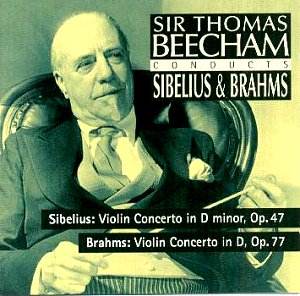
 Royal Philharmonic Orchestra/Thomas
Beecham
Royal Philharmonic Orchestra/Thomas
Beecham