This work was commissioned by Zubin Mehta and
the New York Philharmonic Orchestra for its 150th anniversary.
It was to be Messiaen’s last completed major work, and was seen
by many to be the summing up of a life in music. Critic Rob Cowan
went so far as to describe the piece as "an inspirational
monument, and one of the greatest compositions of the post-war
period". I would not disagree; the piece encapsulates all
Messiaen’s strongest stylistic attributes, and the 11 varied movements
make up an orchestral feast that is eminently accessible. Anyone
who loves Chronochromie or Turangalila should find
much to enjoy in Èclair, though whether this Hänssler
disc is the way to get to know it is another matter.
The problem is that there is already some stiff
competition. Hot on the heels of an excellent 1993 Jade disc from
Antoni Wit and his Polish Radio Orchestra (now familiar regulars
for Naxos) came what is probably the finest version we are likely
to ever have. Myung-Whun Chung has a special affinity with the
music of Messiaen, and his 1994 DG disc with the Bastille Opera
Orchestra won rave reviews. Though I am not a stickler for the
stopwatch, a glance at the timings of these two versions with
Cambreling’s Hänssler disc gets to the heart of the matter.
Wit’s comes in at 63 minutes, Chung (who was seen as allowing
much more time for the textures to ‘breathe’) at 66 minutes and
Cambreling at an astonishing 76 minutes. To put 10 minutes on
an already slow-ish performance is provocative, some might say
reckless. It certainly causes problems, but should not be dismissed
out of hand, as this mostly contemplative score can just about
take it.
A case in point is the opening movement, Apparition
of Christ in Glory. It is basically a sequence of noble, sonorous
chords that move as a slow chorale. They build in intensity, with
long pauses between repetitions, and it could be argued that Cambreling’s
very leisurely pulse allows the effect of a massive, monolithic
Gregorian chant for orchestra to achieve its full impact (Track
1, 0’00). Chung is determined to get a hint of textural variety
in the repetitions, and the effect is one of awe and wonder, but
Cambreling is also very effective.
He is less successful in other movements. The
worst example is probably the fifth, entitled Dwelling in Love,
where a warm cushion of string only texture is rather too lovingly
handled. This is the longest section anyway, but Cambreling’s
14’48 gives us just a bit too much of a good thing (Track 5, 0’00).
Others may, of course, feel it needs just this sort of indulgence
in order to summon the composer’s grand and mystical vision, but
hearing Chung confirms that a tighter rein is desirable.
Of the other movements, I was impressed by Cambreling’s
handling of the difficult ninth movement ‘A Number of Birds
in the Tree of Life’, where Messiaen writes his last birdsong
piece. Here no fewer than 25 birds are impersonated simultaneously
by 18 woodwind instruments, showing us the image of Christ as
the Tree of Life and the birds as the souls of the blessed. Cambreling’s
excellent wind players conjure up a myriad of colours, and the
slow basic speed here works in his favour (Track 9, 0’00). The
terrifying power of the sixth movement ‘The Seven Angels with
Seven Trumpets’ is not as fully conveyed as in the Chung,
who revels in this sort of orchestral dynamism, and the Bastille
Orchestra is also a touch more precise in the tricky chords and
harmonies. The DG recording also allows a greater space around
the instruments, so that what is already a transparent score reveals
its colours even more.
It sounds like there is no competition, and it
is difficult to recommend Cambreling over Chung, who worked intensively
with the composer towards the end. There is no price advantage
either, but Cambreling does offer another view on the piece, one
that I’m sure he feels is entirely valid. It is not to be dismissed
outright, but unless you want two recordings of this wonderful
work (not as daft as it sounds) Chung will ultimately offer more
rewards,
Tony Haywood
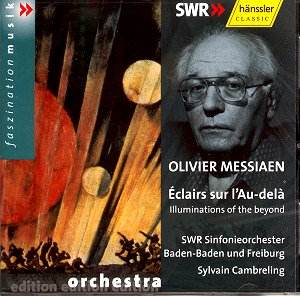
 SWR Symphony Orchestra
Baden Baden and Freiburg/Sylvain Cambreling
SWR Symphony Orchestra
Baden Baden and Freiburg/Sylvain Cambreling