Mascagni conducted a number of his works in the
theatre and on record. Being the composer of a highly successful
work does not, however, necessarily confer the ability to draw
out the best performances of one’s own work. Indeed, Mascagni’s
studio recording of this work, made in 1940 with the same soprano,
his favorite Santuzza, and Gigli as Turridu, is renowned for dilatory
tempi and some sloppy ensemble (Naxos Historical). In this, and
other known theatre performances, his beat and rhythms were much
more dynamic and the theatrical impact considerable. In this recording
his timing, including applause beats Sinopoli, no slouch, on his
1989 recording (DG) featuring Baltsa and Domingo, each thrilling
in their roles.
Live recordings do, however, have their downside
in respect of recording quality, stage noise and the intrusion
of applause. In this issue, all these factors, and surface noise
(tr.16), play a part in limiting one’s enjoyment of a vibrant,
well sung, dynamic performance. In the prelude the harp is clearly
heard, but here, and elsewhere, the strings lack presence and
depth, making the recorded texture sound rather ‘heavy’. Audience
coughs and stage noise as well as applause is to a degree intrusive.
The effect of such intrusions can be mitigated, in the overall
assessment, if compensations are to be found elsewhere, and certainly
that is so in the performance of Lina Bruna Rasa as Santuzza.
Born in 1907 her fragile psychological state limited her career,
but in this performance one or two pitch lapses apart, her vibrant
and dynamic representation of Santuzza’s moods is formidable.
Nowadays we are used to creamy even vocalization that often forgets
that verismo isn’t just beauty of tone but real life; the life
of love, anger and hate and these are the characteristics that
blaze out in this interpretation (trs.4 and 11). As her lover,
Melandri is rather thick-toned and baritonal in timbre. He created
Falco in Mascagni’s ‘Isabeau’, and recorded Mefistofele and Fedora
for Columbia. On stage he sang Radames, Samson and Cavaradossi,
all big voiced roles and this is what he gives here. He lacks
the finesse of Gigli on the studio recording, but his characterization
is strong and appropriate, particularly in his duet with Santuzza
‘Ah! Lo vedi’ (tr.11) which is hair-raising in its dramatic intensity.
Afro Poli as Alfio is the kind of baritone that used to ‘grow
on trees’ in Italy. Strong of voice with well covered and colored
but virile tone, he sang Marcello in the 1938 HMV recording of
La Boheme with Gigli as Rodolfo. His way with words (tr.5) conveys
clearly what Turridu is up against, did he but know it, by dabbling
with his wife. Lola, by the way, is sung with clarity but little
distinction by Maria Meloni. The fact that the cast are native
speakers is a great benefit to the performance.
Richard Caniell provides his usual informative
biographical and performance notes as well as information on the
recording sources including details of the interpolation of some
of Melandri’s lines, from a 1930 performance, that would otherwise
be missing.
Robert J Farr
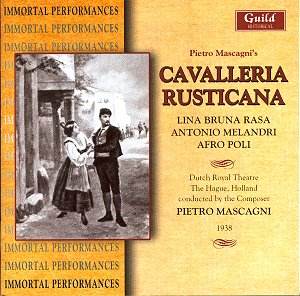
 Chorus and Orchestra
of the Opera d’Olanda Dutch Royal Theatre, The Hague, Holland. Conducted
by the composer, Pietro Mascagni.
Chorus and Orchestra
of the Opera d’Olanda Dutch Royal Theatre, The Hague, Holland. Conducted
by the composer, Pietro Mascagni.