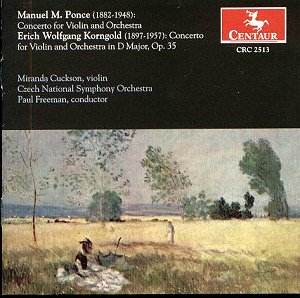
Written five years before his death, the Violin
Concerto was Ponce’s last major work. It has always been closely
associated with Henryk Szeryng, to whom it was dedicated and by
whom it was premiered. His recording of it was last available
on ASV CDDCA 952 and was first available on an HMV LP. This was
a fairly late recording by the sixty-six year old violinist and
his reflexes, and vibrato, have very slightly slowed although
it is still a strikingly successful performance. His hegemony
in the work was almost total and in fact dedicated Ponce-Szeryng
admirers can seek out other recordings made or taped over the
years. The first was with the Colonne Orchestra and Bour (the
premiere recording) made for Odeon. Others include a live Preludio
featuring the fiddler back on his native soil with the Polish
National under Krenz from 1958 and a Melodiya traversal with the
USSR State under Khaikin. The ASV is with the RPO and Bátiz,
made in June 1984, three years before Szeryng’s death. So much
for Szeryng. How about the Centaur newcomer?
Cuckson is an agile player with an attractive,
centre-of-the-note clarity. She brings reserves of technique and
lyrical elegance to the Ponce, a work that can appear – or maybe
is – diffusely eclectic, especially in the longish opening movement.
That said I’ve always loved the deeply lyrical second subject
over a pedal point – most attractive here – and the scurrying
but rather conventional passagework for the soloist. The tension
between the national and modernist idioms is never quite resolved,
but it is notable how well Ponce integrates native dance elements
into the fabric of the first movement. This is something for which
historically he has been given somewhat less than his due, I think.
There are occasional hints of Hindemith along the way as there
are, more rapturously, of Delius in the passage immediately before
the extensive cadenza. The triplet-insistent coda is well played
here – though surely the final bars are somewhat too grandiose,
more Ponce’s responsibility than the orchestra’s. As is well known
Ponce embeds his 1910 Greatest Hit, Estrellita, into the
second movement – fragmented, alluded to, half revealed. The notes
don’t discuss it but I was always under the impression that Estrellita,
like Elgar’s Salut d’amour, was one of those songs sold
cheaply to a publisher. If so the reminiscence takes on an ambiguous
air; memories of Ponce’s celebrated song, regret, bitterness?
Well, it certainly doesn’t sound bitter because this is soaringly
lyrical music, played with perhaps too much restraint here. The
Czech National sounds a bit earthbound. The finale is a Corrido
dance, impressionistically elegant, with some cool orchestration.
The winds can turn exotic but the strings remain discreet and
gradually the giocoso sprit pervades the whole band. This
is certainly an attractive reading – a little small-scaled and
with occasionally diffuse orchestral support.
Coupled with the Ponce is the Korngold, an unlikely
disc-mate I’d have thought but one written a couple of years after
the Ponce. I say ‘written’ but stitched, weaved, fashioned, edited,
compiled and elaborated would be better words to describe this
joyous if sinful confection. Not only is it an unusual choice
to accompany the Ponce but it owes its life and existence to an
equally unlikely begetter – not Heifetz, as many think, but none
other than the arch Philosopher of the violin, proposed architect
of Pan-Europeanism as a political concept, the youth who played
to Brahms, Bronislaw Huberman. It wasn’t Huberman who premiered
it – that was Heifetz, whose recording still holds sway
and who reveled in its glittering virtuosity and vocality, its
glorious lyricism and surging drama. You can find much, though
not all, in this performance. She stresses the chaste lyricism
at the heart of the Romance (with its Anthony Adverse
Straussisms) and is bracingly attentive in the Finale. She must
yield to others in matters of tonal effulgence but otherwise this
is a winning performance. Indeed this is an attractive if, again,
unusual coupling of two mid-century works that embody entirely
differing musical aesthetics to make their points.
Jonathan Woolf
 Miranda Cuckson (violin)