AVAILABILITY
www.concertartistrecordings.com
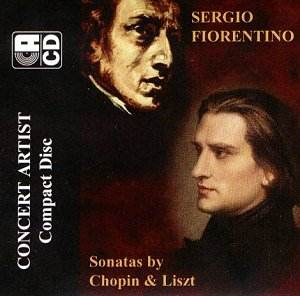
It was Concert Artist’s ambition – largely realised
– to record Sergio Fiorentino’s Chopin in its entirety. As their
notes make clear, Fiorentino recorded the B minor Sonata twice
– as indeed he did the Liszt B minor. The early recordings on
this new CA release date from 1954-59 and make their first ever
appearance here. I have written a number of times about Fiorentino’s
pianism and musicianship on this site. This still-controversial
musician continues to generate heat whenever a disc is unearthed
from the vaults. My admiration is undimmed though I have to register
some disappointment when it comes to the Chopin Sonata. When I
seem less than convinced by him this is not to imply some fatal
turning away from his patrician elegance, his tonal poetry and
his unostentatious control. Rather it is a difference, I suppose,
of conception.
My problem with the Chopin is its inconsistency
– or what I take to be its inconsistent tone. The first movement
is deeply poetic, beautifully nuanced, with a liquid aristocracy
of phrasing, a wonderful touch. His rubati, too, are excellently
judged, a perfect Fiorentino-Chopin performance in fact. The Scherzo
is full of crisp vivacity with a notably sensitive trio. I totally
part company with those who find Fiorentino uninflected and cold.
No, the problem for me lies in the last two movements, the Largo
in particular. Its slowness is a relative matter – though it is
quite slow – but what is more troubling is the lack of flow of
the melodic line, its static quality. There are times when rhythmic
lethargy is not far away. Despite his compelling, indeed outstandingly
beautiful singing tone, one can’t escape the feeling that the
extremes of tempo-rubato are being utilised and that the movement
is being subjected to a degree of lassitude it can’t ideally bear.
As for the finale, I’m still undecided. My first impression, subsequently
relaxed, was that it all sounds rather mechanical. Then doubts
resurfaced. At points the left hand overbalanced the right, the
melody line seemed to disappear fractionally and there was a lack
of differentiation throughout. In the end I again found it tinged
with mechanism. Which is a shame because I admire Fiorentino greatly.
Luckily the rest of the disc seems to me very much more successful.
The Liszt Sonata was recorded at the Conway Hall
in June 1955. All Fiorentino’s best qualities are put at the service
of a highly crafted and immaculately voiced performance. There
is splendid fluency, total avoidance of brashness and forcing
at the climaxes, clarity but never lack of emotive engagement.
The Quasi adagio section is especially impressive. Fiorentino’s
structural control here seems very much more acute than in the
Chopin. The tone is at all times very – that word again – beautiful.
There are obviously, as in the performances of all superior artists,
moments of contention. There are times when there seems a slight
lack of control in the faster sections particularly the Allegro
energico. Against that there is a hair-trigger sensitivity in
the Lento assai that is as compelling as it is impressively controlled.
On balance the two Chopin Ballades are only intermittently impressive.
His rubati in the G minor are certainly highly personalised and
whilst there’s plenty of assurance in the playing there is also
a sense of disengagement. The A flat is full of some filigree
playing but I found parts of it just a little dogged.
So, a mixed reception for this Fiorentino release.
His many admirers, of course, need not hesitate as this documents
more rare material in his ever-expanding discography. Clearly
there must have been a lot of restorative work on the decades
old tape but the sound itself is unproblematic. There are no edits
that I can hear and no deterioration either. As for the quality
of the performances – for me, frustratingly uneven.
Jonathan Woolf
 Sergio Fiorentino
(piano)
Sergio Fiorentino
(piano)