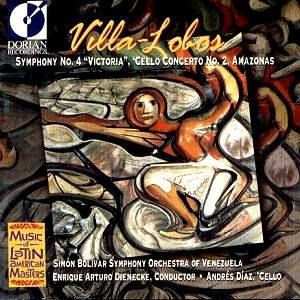
In an admirably well-chosen disc, scintillatingly
played, we meet Villa-Lobos in all his multifarious colour. He
wrote twelve symphonies between 1916 and 1957 and of these Nos.
3, 4 and 5 were conceived as a cycle charting the ideas of war,
victory and peace. As its subtitle suggests No. 4, written in
1919, takes Victory as its theme and Villa-Lobos uses big and
powerful orchestration to make his point. A fanfare section
– a brass band within a band – is also employed, as are extra
woodwind and percussion sections. Villa-Lobos had sought to integrate
Franco-Russian affiliations into his scores and these are certainly
discernable – but so is his considerable individuality of utterance
when it comes to orchestral power and colour. The Symphony for
example opens with strident brass and ominous cymbals, inherently
insistent and dramatic, allowing some swirling melodies for the
strings redolent of the noblest of despair. By the time we arrive
at the diaphanous little Andantino, which quotes La Marseillaise,
the brass have assumed a rather hieratic, antiphonal status and
the music has developed to embrace songfulness after the troubled
dark night of the soul in the opening movement. Where Villa-Lobos
most impresses however is where his instrumentation thins, where
concision is at its tightest and that’s in the slow movement.
The subtle funereal tread of the Andante and its embracing of
French impressionism – an elegy of excellently judged purpose,
scored with apposite seriousness. The finale contains reminiscences
of other movements and its scoring is jubilantly and expressively
rich. The brass continues its journey from darkness to light,
here being drenched in cathartic effulgence. The winds are chirpy,
the instrumentation rich and lots of (perhaps over-) scored vibrancy
colours the movement from within.
Amazonas (1917) one of his best-known
ballet scores derives from the 1916 tone poem Miremis.
Only eleven minutes long this is nevertheless a quintessential
slice of Villa-Lobos exotica, vibrant, colourful, bursting with
originality and piquant instrumental juxtapositions. He uses a
big, augmented orchestra once again and lavishes a wealth of evocative
sounds upon it. From the ominous undertow of the first bars we
are gripped by a sense of place, of texture, heat, smell and birdsong.
The rhythmic chirping, the hot-house and haze, the bristle and
burnish are all gloriously evident and magnificently so in this
performance. The occasional eruptions from the trombones add theatre
and incident to a score already packed with colourful felicities.
The final work on the disc is the much later Second Cello Concerto.
It was written for Aldo Parisot, dedicatee and first performer;
he also made the first recording. The orchestration is very much
sparer here and Villa-Lobos exploits moments of technical demand
and lyrical reflection for the soloist. The work in fact opens
with a kind of ruminative quasi-cadenza for the cellist, Andrés
Días, who copes admirably with all demands. The slow movement
is a particular high-point in this recording – an effortlessly
unfolding cantilena whose Bachian affiliations are never subdued.
The dancing Scherzo, incisive and vocalised, enshrines a virtuosic
cadenza, full of dramatic glissandi. The Concerto ends with vibrant
and rhythmic surety and there’s plenty of local colour along the
way as the cello protagonist steers triumphantly to the final
coda.
Soloist, orchestra and conductor sound in one,
affirmative accord and Dorian’s recording is splendidly spacious.
This is a genuinely accomplished contribution to Villa-Lobos on
disc.
Jonathan Woolf
See
also review by Len Mullenger
 Andrés Días
(cello)
Andrés Días
(cello)