Rehearsal sequences are a minority interest but
they do afford, or can afford, a degree of specificity into a
musician’s working practices. Familiarity with Beecham’s avuncular
mugging or Walter’s quiet insistence will doubtless prepare one
for the seismic, volcanic and characteristically Toscaninian bellow
– a compound of Caligula and Krakatoa – that erupts every so often.
What Relief present here is an orchestral rehearsal for the commercial
RCA Victor discs that were recorded a few days later. Toscanini
sings along for much of the time, enacting in his coarse croak
an impassioned identification with the score. His concentration
on diminuendos and scrupulously crisp rhythm is evident. He goes
mad when he thinks the rhythm is getting lax, an extrapolation
of the musicians’ laziness and inattention to detail enraging
him beyond measure. He can also relax a little; some wintry shafts
of humour are here as well but the overriding impression is one
of businesslike tension.
It would I think be inappropriate to review this
as if it were a finished performance, even more since this is
an orchestral rehearsal. However some points did strike me forcefully
when listening. The brisk repetitions of certain key sections
in the opening scenes of Act I allow one to appreciate the sympathetic
moulding of cello phrases (Toscanini was a cellist of course).
His bravo to the section is a professional mark of respect.
In the passages following Quale insolita gioia we encounter
a terrifying ordeal as, after some sectional balances, Toscanini
throws a couple of fits. I’ve heard rehearsal sequences before
when he turns on the basses as he does here: Articulate contrabassi
he barks out in a daemonic shout. And yet a few minutes later
he induces some laughter in the orchestra ‘Ave you ‘ad your
lunch? Aaahh that followed specificities concerning
staccato articulation and a mistake in the score. Toscanini generally
talks in Italian, sometimes employing a polyglot vocabulary: once
or twice exclusively in English.
It’s extremely compelling to hear him insist
on the correct placement of the piano in a phrase and the
very intense but utterly single-minded way he can stride through
a long passage without stopping to fuss over detail. But just
as things seem to be simmering down, after what was apparently
a longish rehearsal, Toscanini does what Beecham told Klemperer
he was about to do to a New York orchestra – I’m going to bring
some electricity into this lazy body. The resultant abuse
Stupido! Stupido! – Look at your music would be
enough to chasten even the toughest Bronx heart. I don’t want
to give the impression that this is the Jaws of orchestral rehearsals
because it’s only occasionally that Toscanini wells up but when
he does it’s generally for specific reasons. In Act II Scene II
we witness a fine exhibition of book slamming, foot stomping and
splenetic bilingual fury. His immortal comment I ‘ate thissa
mistake is a particularly fine form of understatement given
the eruption just visited on the orchestra but, as ever, ten minutes
later sees him fulsomely congratulating them. One of those specificities
that generated his localised but volcanic temper was rhythmic
laxity and inexactitude. From rehearsal letter E, più mosso,
his choleric stamping niente frightens any passing horses
but certainly has a beneficial effect on the rhythmic profile
of the playing which instantly tightens in incision – as well
it might.
Not a CD for the generalist but a fascinating
document nevertheless; I think most or part has been available
before on LP, RCA and Franklin Mint. As for the so-called Aida
Overture, included as a quasi-appendix that was a premiere recording
and has seen the light of day on a number of LPs and CD reissues.
Jonathan Woolf
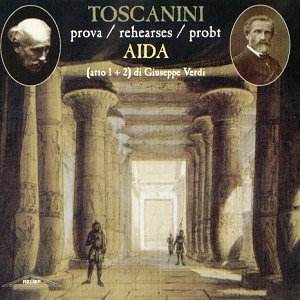
 NBC Symphony Orchestra/Arturo
Toscanini
NBC Symphony Orchestra/Arturo
Toscanini