For more than 50 years few classical record collections
will not have included some, if not all, of the Beethoven symphonies
and concertos, and by now most collectors will have their own
firm favourites. Today, however, an increasing number of recordings
provide opportunities for a re-assessment of both familiar and
unfamiliar works. This ‘historically informed’ approach is not,
as some may imagine, an exercise in antique restoration but a
genuine attempt to see these works in the light of current musicological
research, textual analysis and Beethoven’s own dynamic markings.
For the listener the real point of all this is what the music
actually sounds like. Following the enthusiastic reception given
to Harnoncourt’s recently released Beethoven symphonies his interpretations
of the piano concertos have been eagerly awaited, and our patience
has been amply rewarded.
From the opening bars of No. 2 (the first concerto
to be published in a version – much of which is now lost
– and later extensively revised by Beethoven) it is clear
that we are in for surprises, but no shocks. Similarities with
Mozart, particularly in concertos 1 and 2, have occasionally been
noted, but the Beethoven concertos span almost the whole of his
creative life and, as usual, he was doing things in his own way
and in his own time. Overall tempi are not noticeably brisk –
indeed often slower than I anticipated – though the
orchestral texture is more transparent than in the opulent approach
favoured by large, glossy orchestras and star conductors, from
Beecham to von Karajan. The first impression is the amount of
fine detail revealed; the next, and most impressive, is the rapport
between Harnoncourt and Aimard, whose crystal clarity and expressive
brilliance is unfaltering throughout. The piano plays with
the orchestra, not against it as sometimes happens, and this
collaboration allows for greater rhythmic flexibility and integration.
Entries are judged with hairbreadth precision, articulation is
exact and convincing and there is no ‘leading’ or lack of nuance.
Beethoven’s orchestra was, by today’s standards, small, and contained
instruments materially different in sound and volume from those
likely to be found in a modern symphony orchestra. The Chamber
Orchestra of Europe plays, as its name implies, with intimacy,
but no lack of gusto. The dialogue between piano and orchestra
falls naturally and gracefully into an integrated, satisfying
whole that preserves the line of the performance and creates an
enchanting sound world that is distinctively Beethoven’s.
The third and fourth concertos use a musical
language that encompasses the composer’s developing imagination
and sensitivity to the delicate balance between orchestra and
piano. For example, the slow movement of No. 3 is taken at a pace
that gives it the time and space needed for its meditative calm
to unfold, and the slowish opening of No. 4 blossoms like a flower,
with Aimard and the orchestra spinning a magical spell that preserves
its gentle character leading to the vigorous arrival of the first
subject.
It is in No. 5 that we find one of the most finely
wrought and beautifully realised performances on these discs.
Its dramatic opening - usually treated as a flourish
to allow pianists to establish their virtuoso credentials –
is treated less as a fanfare and more as an important part
of the whole movement. Thus through all three movements colour,
excitement, high spirits and mature reflection, arrive with a
sense of inevitability at the brilliant, technically daunting
finale, effortlessly captured by orchestra and soloist. The concerto
is cyclic in form – a ‘symphonic concerto’ in which subtle
thematic interplay is vital – and, once again in this interpretation
we come close to its noble heart.
Whether or not you already possess recordings
of the piano concertos this set will be a revelation of how far
we have moved towards a synthesis between what we expect from
the music and what can still be revealed by dedicated musicians.
Every performance of a work is, in a literal sense, ‘new’, and
I will continue to treasure outstanding, though radically different,
versions of the concertos, such as the 1968 album from EMI with
Barenboim and Klemperer. Such readings are not rendered invalid,
much less obsolete, but it is impossible not to feel that, on
this occasion, we have come appreciably closer to understanding
how Beethoven wanted them played.
In the accompanying booklet Aimard writes ‘Never
would I have imagined that I would one day be recording these
concertos’. We must be grateful that the time has arrived for
him to do so with such manifest success. The booklet also contains
an informative essay by Wolfgang Sandberger.
Roy Brewer
see also
review by Christopher Howell
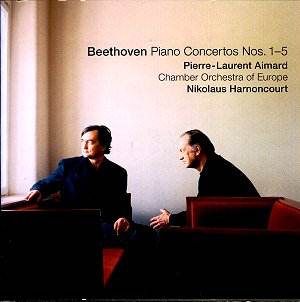
 Pierre-Laurent Aimard
(piano)
Pierre-Laurent Aimard
(piano)