Having recently
reviewed a splendid Tahra set of CDs featuring the Concertgebouw
Orchestra and Pierre Monteux it has been most interesting to
listen to this set which celebrates their relationship
with another honoured guest conductor, Karel Ančerl.
Ančerl (1908-73)
was a pupil of both Hermann Scherchen and Václav Talich. He
suffered greatly during the Second World War when not only was
he driven from his conducting career but also, infinitely more
seriously, the Germans incarcerated him along with his entire
family. He was the only one of his family to survive the Holocaust
and one can scarcely imagine the effect this must have had on
him. Resuming his conducting career after the war, he eventually
became Artistic Director of the Czech Philharmonic in 1950.
Following the Soviet invasion of Czechoslovakia in 1968 he resigned
that post and for the remainder of his life he focused on his
post as Chief Conductor of the Toronto Symphony Orchestra (which
post he had originally intended to combine with his duties with
the CPO) and on guest conducting.
Ančerl’s
links with the Concertgebouw go back as far as did Pierre Monteux’s.
He first appeared with them in 1933. However, thereafter his
career was centred largely on his native land. This meant that,
unlike Monteux who was a regular visitor to the Concertgebouw
podium, Ančerl did not reappear with the orchestra again
until 1966. In that year he visited them for what was to be
the first of three spells as a guest conductor. The recordings
in this collection stem from the second and third of those visits.
The Prokofiev symphony was played during a series of concerts
in 1969 and the other items all featured in what was to be his
final series in Amsterdam during 1970.
All the recordings were made by the Dutch broadcasting
company, NPS Radio and have come up sounding very well indeed.
Apart from the intrinsic interest of the performances the set
will be welcomed by admirers of this conductor as two of the
pieces, the Haydn and Franck, were
never recorded by him commercially. Surprisingly, there is no
studio recording of the Dvořák symphony either.
The performance
of the Dvořák 8th is actually the same
one recently included in the most desirable EMI Classics set
devoted to Ančerl in their ‘Great Conductors of the Twentieth
Century’ series. An A/B comparison of both issues indicated
that, on my equipment, the EMI transfer, which is more recent,
has just a touch more punch and presence. However the Tahra
transfer is also very good, giving clear, well-focused
orchestral sound and forthrightly conveying the ambience of
the hall.
The Eighth is
my personal favourite in the Dvořák canon so it’s good
to report that Ančerl directs a spirited, fresh performance.
The main theme of the first movement moves along nicely,
with no indulgence. Here, and in the rest of the work for that
matter, there’s great clarity of texture, indeed, that’s a quality
present throughout the set (for which the Dutch engineers must
take their share of the credit). The slow movement is warm and
affectionate. Perhaps this music above all reminded Ancerl that,
after the events of 1968 he was unlikely ever to see his homeland
again. Even if this were the case, his account of this lovely
movement evinces no sentimentality (though there is an
appropriate level of sentiment). There is lilt and charm in
the Allegro grazioso: the rustic inflections sound just
right. Ančerl’s control of
rubato is effortless and, as one would expect, wholly idiomatic.
The finale is exuberant and packed full of rhythmic zest, capping
a most enjoyable and satisfying reading of this vernal work.
I liked Ančerl’s
Classical symphony as well. The first movement
is played at a tempo which is just sufficiently measured to
let the music breathe. The various strands of the argument emerge
clearly – it’s not a scamper like the amazingly fleet account
by Koussevitsky and the Boston Symphony in their 1947 traversal
for RCA. While I find the Bostonians very stimulating I
prefer Ančerl’s rather more restrained approach. To me
it underlines more successfully the eighteenth century allusions.
In the larghetto the orchestral sound may seem
somewhat big-boned for some listeners’ tastes but I think you’ll
still find grace and charm in the playing. The helter-skelter
finale fairly fizzes along in a performance full of infectious
gaiety. I enjoyed this performance immensely and so too, it
seems, did the Amsterdam audience.
His Haydn is a ‘big band’ performance but it
is still stylishly done, reminding us that good performances
of classical symphonies need not by any means be the preserve
of period ensembles. Here, the Dutch strings are lithe and the
winds agile. Generally, phrases are nicely turned and, as elsewhere
in the set, one is impressed by the clarity of the performance.
I found both of the first two movements had plenty of charm
and grace. Some listeners may well find the minuet a touch heavy
and emphatic. However, in my view the spirited, characterful
playing compensates for any minor reservations over the basic
tempo. The finale quite simply sparkles and dances. In summary
I found this a most enjoyable, carefully prepared performance.
I’m afraid I’ve never really warmed to Franck’s
symphony. To my ears the thematic material
is not desperately interesting and is stretched a little further
than it can really bear. In addition, the rhetoric seems overblown.
This was not a piece which I would have associated with Ančerl
but he makes a pretty good case for it. I’m sure that part
of the reason for the success of the performance is that Ančerl
exercises his usual care for orchestral balance and clarity.
Furthermore, his approach is objective and he refuses to wallow
in the rhetorical passages.
The slow introduction to the first movement
gives a good foretaste of what is to follow. It is sober and
powerfully built, full of suspense. In fact, in terms of tension,
I’d put the account of this passage on a par with Guido Cantelli’s
1954 recording with the NBC Symphony Orchestra (now on
a Testament set, SBT2194, which is indispensable for admirers
of that short-lived maestro.) In fact, as Ančerl’s performance
unfolds it seemed to me to have much in common with Cantelli’s
reading for both are dark as well as dramatic.
The discursive first
movement as a whole is strongly projected and in the places
where Franck is wont to linger Ančerl very sensibly keeps
the music moving forward. In the slow movement he encourages
warm, intense playing from the Concertgebouw players. The finale
is robust and purposeful
but I find the invention in this movement is pretty thin and
even the fine sense of conviction which Ančerl brings to
the proceedings can’t quite convince me, I’m afraid. Nonetheless,
this is a cogent, well played reading of the symphony and
listeners who rate the work more highly than I do will find
much to admire here.
The documentation
consists of a short but informative note, mainly about Ančerl’s
links with the Concertgebouw Orchestra. The note is provided
in French, English and Italian and there is a transcript
of the recorded interview in each of these languages also. The
interview, which completes the second disc, is an interesting
if rather general little piece. It was recorded in July 1968
in Prague, presumably by a local, English-speaking
interviewer for the Canadian Broadcasting Corporation. The focus
is primarily upon Ančerl’s plans for his forthcoming relationship
with the Toronto Symphony Orchestra. At that time the conductor
envisaged combining his duties in Canada with his work
at the helm of the Czech Philharmonic. Sadly, this was not to
be. Only a few weeks later Brezhnev’s tanks rolled into Prague
and Ančerl, then guest conducting at Tanglewood, resigned
his Czech post, never to return home.
This is a most valuable set. Admirers of this
fine conductor will welcome it, particularly since it allows
us to hear him in repertoire which is not otherwise included
in his recorded legacy. The Dutch radio recordings are very
good and Tahra’s transfers of them are excellent. Without exception
the performances collected here are thoughtful, well prepared
and thoroughly musical. They are directed by a clear-sighted
conductor who communicates the music lucidly and with conviction
and who is able to command first rate playing from his orchestra.
Tahra have put us in their debt by issuing
this set which I warmly commend.
John Quinn
See also
review by Jonathan Woolf










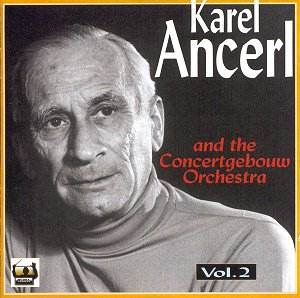
 Concertgebouw Orchestra,
Amsterdam/Karel Ančerl
Concertgebouw Orchestra,
Amsterdam/Karel Ančerl