Very little of Albinoni’s immense output of
compositions has survived, unlike those of his better known
contemporary Vivaldi. The two composers even lived and worked
in close proximity in Venice. However, it is said that Albinoni’s
instrumental music, unlike that of Vivaldi, is almost a by-product
of his operatic music, with long breathed and eminently singable
lines which remind many commentators of operatic ‘bel canto’.
Albinoni was a most proficient singer and was fortunate to have
a comfortable private income which allowed him to pursue a full
time musical career, including the composition of over 50 operas.
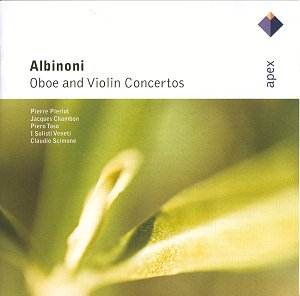
On this Apex release seven of the twelve opus
9 concertos published in Amsterdam in 1722 are included, and
they are indeed fine works. All the concertos are in the three
movement fast, slow, fast, form that Albinoni was probably the
first composer to use consistently in his concertos. Often accused
of displaying a lack of harmonic finesse, these opus 9 concertos
bear testament to Albinoni’s melodic gifts together with a pronounced
individuality which was most probably due to the relative insularity
of his life.
The highlight of the disc is the haunting and
meditative adagio from the popular oboe concerto No.
2, which I feel must have been the inspiration and model for
the main theme from Geoffrey Burgon’s 1980’s score to the TV
drama Brideshead Revisited. In addition, the concerto No. 3
for double oboe is most appealing and proves to be a inventive
work. In particular, the opening allegro is notable for
the consistent flow of its musical line. For me, the concerto
No. 1 for solo violin is the weakest and least memorable of
all the concertos on this release, particularly when compared
to those concertos for the oboe, which are clearly of a high
melodic standard.
Pierre Pierlot, the oboe soloist, has a beautiful
tone, and his playing is distinguished and easily conveys the
spirit of the music. In addition, Jacques Chambon in the double
oboe concertos and Piero Toso in the two violin concertos are
expressive and fluent in their interpretations. Under the persuasive
direction of Claudio Scimone the performance of the ensemble
I Solisti Veneti invite admiration, displaying how assured they
are in this repertoire.
The performances are naturally caught and mainly
well recorded; however I would have preferred slightly more
prominence in the bass line harmonies. The disc’s total timing
of just over 71 minutes is generous but unfortunately Apex have
provided sparse booklet notes and there is no information concerning
the recording venue and dates. For the quality of the music,
the standard of performance and the modest cost this disc will
prove a welcome addition to any collection of late baroque music.
Michael Cookson










 Piero Toso (violin)