Schönberg’s Verklärte Nacht
Op.4, either in its original version for string sextet
or in the transcription for string orchestra made in 1943 by
the composer, is probably one of his best-known works. Inspired
by a somewhat outdated poem by Dehmel, this work is still in
a fairly traditional Romantic, though chromatic idiom with a
direct appeal. It is a clear example of early Schönberg,
fairly accessible (probably more so in the orchestral version),
richly melodic and lushly scored. By contrast, the First Chamber
Symphony for chamber orchestra is a more compact, tightly argued,
more austere piece of music written as a reaction (or an antidote)
to the many large-scale Romantic works that have preceded it
such as Mahler’s Eighth Symphony or even Schönberg’s own
Gurrelieder. It is in five concise movements with
many thematic cross-references. In the wake of this work, Schönberg
started composing a Second Chamber Symphony as early as 1906,
worked on it intermittently but completing it only in 1939 (hence
the opus number). Originally planned as a three-movement piece,
it was eventually published as a two-movement torso (the last
movement remained in short score). Heinz Holliger conducts virile,
no-nonsense readings that I find most appealing.
American Music for Strings. The second
CD in the present set offers an interesting, albeit rather ungenerous
selection of American string music. Barber is, interestingly
enough, represented by his rarely heard, youthful Serenade
for Strings Op.1 written in the late 1920s which already
displays Barber’s inborn lyricism. Carter, too, is represented
by one of his earliest works, the Elegy of 1943
that also exists in a version for string quartet (recorded by
the Arditti Quartet; there are other versions as well) and that
is a clear example of Carter’s early Neo-classicism. Irving
Fine’s music is too rarely heard, if at all, and here is a good
example of his music, the deeply felt elegiac Serious
Song, a commission from the Louisville Orchestra. Finally,
Diamond’s Rounds, composed in 1944, is one of
his best-known pieces though it does not enjoy the popularity
it deserves. In spite of its shamefully short playing time,
this CD is probably the most appealing of the whole set, were
it only for the rarities it offers.
Bartók’s and Lutosławski’s
concertos for orchestra are quite popular works. Both have often
been recorded and both have shared the same disc. They actually
have much in common and Lutosławski’s admiration for Bartók
is well known. Lutosławski’s is, I think, the finest of
the two for Bartók’s piece, written during the difficult American
years, is not his finest achievement in spite of the many outstanding
moments. On the whole, it is too long, too heavily scored
and somewhat uneven; but it was – and is still is – an important
work in that it renewed Bartók’s compositional powers.
(It was actually followed by the masterly Sonata for Solo
Violin written for Menuhin.)
Lutosławski’s Concerto for Orchestra
is the culmination of the composer’s Neo-classical, folk-inspired
period. It cleverly uses Polish folk songs woven into a rather
complex fabric. Its first performance was an immediate success
(no wonder!) and the work has remained his most popular work
since. Sir Andrew Davis conducts a particularly fine reading
of Lutosławski’s work. His
reading of Bartók’s concerto is quite satisfying in its own
right, although there may be more distinguished readings of
it available.
Messiaen’s Quatuor pour la fin du Temps
was composed when the composer was a prisoner-of-war in Germany
and was first performed at Stalag VIIIA in Görlitz with
the composer at the piano. This must have been a quite rare
happening besides the several performances of Krasa’s Brundibar
in Theresin. As is often the case with Messiaen, the music reflects
the composer’s religious concerns and evokes, in Messiaen’s
own idiosyncratic fashion, words from The Revelation of St.
John. This substantial score is quintessential Messiaen
whose main hallmarks, melodic, rhythmic and harmonic as well,
are all present throughout, even at this comparatively early
stage of his composing career. Not having heard this work for
a very long time, I was delighted to hear it again, in a wonderfully
committed performance by Brunner and his colleagues of the Trio
Fontenay.
All in all, this is a fine and welcome compilation.
The only problem, though, with similar releases, is that you
may already have some of these pieces on disc; but you need
not hesitate to get this boxed set if you do not know these
pieces, some of which are absolute 20th Century classics.
Hubert Culot










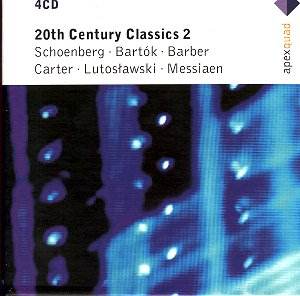
 APEX 0927 49421-2