2003 will be – or, at least, should be – Jongen’s year celebrating
the fiftieth anniversary of his death. Jongen was undoubtedly the most
important Belgian composer of his generation. He also played a major role
in academic circles. As a conductor, he was also responsible for some
early performances of many important works from the first half of the
20th Century. But he will be primarily remembered and admired
as a most distinguished composer with a huge and varied output from which
opera is conspicuously absent. Besides a number of orchestral works culminating
in what may rightly be considered as his greatest masterpiece, the masterly
Symphonie Concertante Op.81 for organ and orchestra of 1927,
he composed a great deal of chamber music including a worthwhile body
of works for cello and piano, of which the large-scale Cello Sonata
Op.39 of 1912 must have pride of place. It is a substantial and
ambitious work in three movements of fairly equal length, still roughly
cast in the Romantic mould; but, to a certain extent, it may nevertheless
be considered as a transitional work absorbing the Romantic frame of mind
inherited from César Franck whose shadow loomed large over Jongen’s
early years and some French Impressionism inspired by Fauré, Debussy
and Ravel. These will remain the main characteristics of Jongen’s music
throughout his long and prolific composing life. The first movement, roughly
in sonata form, alternates a declamatory first subject and a more relaxed
flowing second one. The second movement is mostly song-like in character.
The last movement, however, is somewhat more complex : it opens with a
long recitative-like introduction leading into the main part of the Finale.
The cello is rarely absent and obviously carries the bulk of the argument,
but the often florid and busy piano part is also quite demanding. Jongen’s
Cello Sonata was dedicated to none other than Pablo Casals,
though we do not know if he ever performed it.
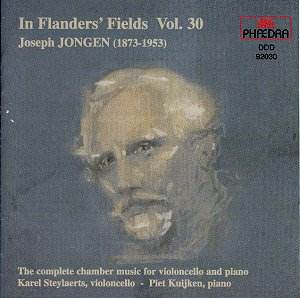
The present release offers the complete works for cello
and piano of Jongen, though it does not include the short Chanson
intime of 1936, which incidentally does not have any opus number.
The earliest piece is the short Feuille d’album of 1892
(no opus number) still steeped in the Romantic tradition of Jongen’s
early works. All the other pieces are also fairly short. The two diptychs
(Op.51 composed in 1916 and Op.68 composed in 1926) are both sets of
character pieces often of great melodic charm such as the beautiful
Dans la douceur des pins Op.51 No.1 written in England
where Jongen and his family had settled after the outbreak of World
War I and where he founded the Quatuor à clavier belge with Désiré
Defauw, Lionel Tertis and Emile Dochard. The Op.68 diptych (Aria
and Moto perpetuo) was written after his return to Belgium. This
superb release also includes the attractive, though light-weight Habanera
Op.86 and ends with the delightful Valse Op.35
of 1909.
I enjoyed the present performances enormously. These
committed and assured readings serve Jongen’s richly melodic music well,
and I hope that Karel Steylaerts will some day record Jongen’s works
for cello and orchestra (there are four of them including the large-scale
Cello Concerto Op.18 of 1900, one of Jongen’s earliest
large-scale works). Anyway, this is a most welcome and desirable addition
to Jongen’s slowly expanding discography. Heartily recommended.
Hubert Culot
| Error processing SSI file
|
 Piet Kuijken (piano)