In many respects Schumann is the archetypal romantic
artist: deeply influenced by literature, committed to powerfully intense
emotions, creatively aware of the virtuosity of performers. He was himself
a fine pianist, and the first twenty-three of his published compositions
were for his own instrument. His marriage to Clara Wieck in 1840 coincided
with a new phase in his creative life, concentrating on song, for in
that year alone he composed some 140 lieder. Then two years later chamber
music became his priority, with three string quartets, and a piano quartet
and quintet, the latter one of the finest examples of the genre.
Schumann also wrote four fine symphonies and three
concertos, one each for the cello, the violin and the piano, as well
as choral music and two works for the theatre. But the man himself remains
something of an enigma, a depressive whose mental anguish resulted in
1852 in a failed suicide attempt, and incarceration in an asylum for
the last two years of his tragically short life. Much of his output
is little known, but there is no doubt that Schumann was one of the
key figures of the romantic movement and one of the great composers
of the 19th century.
Schumann was not fully at home with opera, despite
the excellent music to be found in his Genoveva. The Scenes
from Goethe's Faust has its operatic qualities, to be sure, but
like Berlioz's Damnation of Faust, it occupies a hybrid position
and is more at home in the concert hall, a kind of dramatic oratorio.
Schumann composed the work for the celebrations of
the Goethe centenary in 1849, although not all of it was complete in
time. It is no surprise that there were such difficulties, since the
music is constructed on an extended scale and composed with great attention
to detail. Here the symphonist and the song writer really do come together,
and the responses to the text and the drama are intensely felt.
Parts 1 and 2 contain portraits and other aspects of
Faust and Gretchen, whereas Part 3 (like the final part of Mahler's
8th Symphony) is concerned with Transfiguration. There are changes of
style and approach as suggested by this epic scheme, but no matter.
For this is a committed and visionary work which contains some of the
best music Schumann ever composed, not least because for him it was
a labour of love.
For example, he wrote nothing more dramatic than the
scene depicting the blinding and death of Faust. Moreover, after hearing
this, who dare suggest that Schumann was a poor orchestrator?
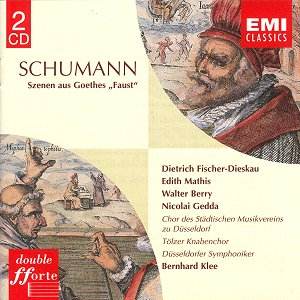
Bernhard Klee conducts a performance of vivid conviction
and drama, though the visionary aspect which comes to the fore in Part
3 is appropriately lyrical in tone. Of the singers, Dietrich Fischer-Dieskau
takes the leading role, as he did also in the recording conducted by
Benjamin Britten (on Decca). It is a tribute to his artistry that he
is equally successful as Faust and, in Part 3, as Doctor Marianus. In
truth there is a distinguished and particularly strong team of soloists
in this performance: Walter Berry, Edith Mathis, Nicolai Gedda are all
at the peak of their form. With very good, truthful recorded sound and
high production standards, this recording still gives enormous satisfaction
twenty years after it was made.
Terry Barfoot
 Dietrich Fischer-Dieskau
(baritone)
Dietrich Fischer-Dieskau
(baritone)