Joyce Hatto was a piano pupil of Zbigniew Drzewiecki
at the Warsaw Conservatoire as was Roger Woodward amongst others. Drzewiecki
(1890-1971) was a strong proponent of the contemporary Polish repertoire
but equally committed to Chopin, on whom he was an authority. She also
studied with Ilona Kabos and Serge Krish, received some guidance from
Cortot and took composition lessons from Mátyás Seiber
and from Hindemith. Record collectors will remember her remarkable Bax,
but there was much else – Mozart, Rachmaninov, Gershwin – and she was
a sterling exponent of Liszt as well, having given the complete original
piano works in a series of recitals, a remarkable and indefatigable
undertaking.
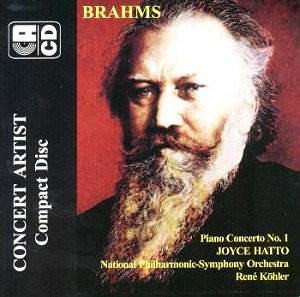
Concert Artist/Fidelio have captured a sizeable chunk
of her repertoire in recent recordings of which this Brahms release
forms part, recorded in 1995 and 1997. New releases are imminent so
I suggest you consult the company’s website (details above) for further
details. Hatto has recorded both Concertos – my review of the Second
Concerto will appear soon – and she displays considerable Brahmsian
qualities; this is a pianist who should be far better known than she
is. I don’t know anything about the National Philharmonic-Symphony Orchestra
(or conductor René Köhler) but the name has a charming Decca
resonance familiar from the days of Sidney Beer, Warwick Braithwaite
and Anatole Fistoulari. The orchestra, it’s true, is recorded in a rather
swimmy acoustic and this saps the lower strings especially with a lack
of clarity that can prove burdensome. But Joyce Hatto is on splendid
form, strong, resilient; she opens up space, little pockets of weighted
time, in the left hand. She never tries to force through the tone or
to engage in tonal mock-heroics. In the Maestoso first movement she
can retard the rhythm with remarkable effect, vesting her chording with
passionate dignity and the verticality of the chords is as noble as
their tone is rich. After noting the problem with the acoustic I should
add that the basses and cellos come into their own in the slow movement
in which at a relatively slow tempo Hatto sustains the questing line
with sensitivity and architectural acumen. The balance between piano
and orchestra is good in the finale and even if the timpani booms alarmingly
it seems to add to the increasingly pawky humour of the reading which
reaches its apotheosis in this performance in the fugal episode, very
well done. Altogether in fact a convincing performance of a frequently
misread work.
The disc ends with three Rhapsodies; the Op. 119 No.
4 is the last of Brahms’ compositions for piano and excellently played
by Joyce Hatto. The Op. 79 Rhapsodies are sensitive and characterful.
She reminds me a little of Kempff in the B minor with a compelling but
deliberately circumscribed tonal palette. In the G minor she begins
well, with choppy left hand and stabbing accents though maybe missing
some of the mystery in the chordal passages – nevertheless she’s keenly
alive and whilst I found a lack of differentiation between piano and
forte and lack of dynamic variance, that could be a recording phenomenon.
As I said it’s no superficial swagger such as even elite pianists all
too often make it (and I recently heard a pianist I much admire, Ivan
Moravec, murder it in concert).
A reading of some considerable distinction then from
a pianist now making a considerable presence once again in the catalogues,
due almost entirely to the dedication and support of a record label
that sticks by artists it believes in.
Jonathan Woolf
see also
JOYCE
HATTO -
A Pianist of Extraordinary Personality and Promise:
Comment and Interview by Burnett James
MusicWeb
can offer the complete Concert
Artist catalogue
 Joyce Hatto (piano)