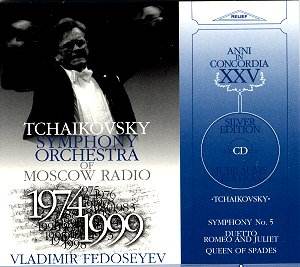
This is another in
the series of CDs celebrating the silver
jubilee of conductor Vladimir Fedoseyev’s
association with the Tchaikovsky Symphony
Orchestra of Moscow Radio. As with the
recording of the Sixth Symphony that
I
reviewed recently, this performance
of another well-known symphony is coupled
with some intriguing rarities.
The music that may
be least familiar to collectors is the
duet from what Tchaikovsky originally
intended to be an opera on the subject
of Romeo and Juliet. He made sketches
for the opera between 1879 and 1881,
including the present duet in which
he reworked material from his celebrated
Fantasy Overture, Romeo and Juliet
(1869). For whatever reason, Tchaikovsky
abandoned the project and did not even
complete the duet. It was finished and
orchestrated after his death by his
friend, the composer, Taneyev. Listeners
will be fascinated to hear familiar
themes from the overture in a new guise.
It receives a fine, ardent performance
here. Soprano Marina Meshcheriakova
has plenty of vocal power but she is
also capable of singing tenderly. Opposite
her is tenor Vitaly Tarashchenko whose
voice is a fine example of that uniquely
Slavic tenor sound, plangent, ringing
and heady. (I hope I’ve got his name
right; it’s spelt in two different ways
in the documentation and I’ve used the
version most frequently employed.) I
found this a most welcome discovery
and the performance fully justifies
the exclamation of "bravo"
from a member of the audience at the
end. I must say, however, that I thought
the applause could have been edited:
forty-nine seconds is a bit too much.
The excerpts from The
Queen of Spades were recorded at
a concert on the eve of the bicentenary
of Pushkin’s birth. Irina Christyakova
is a commanding, histrionic mezzo, very
much in the Russian tradition. Like
several of her compatriots, she has
a pronounced vibrato, which I found
a bit wide for my taste. However, she
sings very dramatically and has real
vocal presence. Tarashchenko is once
again the tenor and he sings with dramatic
fervour and with great intensity. In
this he is matched by the orchestra.
In these excerpts the singers and the
orchestra are more closely balance than
is the case in the symphony or in the
Romeo and Juliet duet. There’s
also quite a bit of coughing and other
extraneous noise from the audience.
At the very end of the Final Scene an
uncredited male chorus appears briefly,
producing a superb, intense Russian
choral sound.
The main item on the
disc is the Fifth symphony. Fedoseyev
directs a performance that is full of
conviction. I suspect that his reading
of the first movement will not be to
all tastes. His basic tempo for the
main allegro is conventionally brisk,
which is fine with me. However, on several
occasions he slows the tempo significantly
although a slower speed is not marked
in the score. Thus, at the passage marked
molto espressivo at bar 116 (track
1, 3’54") the brakes are applied
quite sharply (the same thing happens
when this passage is reprised at 10’10".)
The trouble with this is that Fedoseyev
thereby anticipates the poco meno
animato by some 12 bars and the
music sounds over-indulged. Again, the
molto tranquillo at bar 170 is
surely too slow? On the credit side,
however, the faster music is undeniably
exciting and the orchestra’s attention
to dynamic markings is faithful throughout.
In the remainder of
the symphony there are no comparable
idiosyncrasies of tempo. The famous
horn solo at the start of the second
movement is played with a very Russian
timbre. This is a sound that is almost
never heard these days but it sounds
so right in this music – and
the solo is very well played into the
bargain. There’s plenty of Russian soul
in the performance of this movement.
The third movement waltz is played with
a graceful lilt. The melody is marked
"dolce con grazia"
at the outset and that’s just how Fedoseyev’s
first violins deliver it. Later on there’s
some fine work by the woodwind principals.
Unlike some conductors
Fedoseyev does not play the start of
the finale too slowly. He thereby avoids
any portentousness but there’s no lack
of weight in the playing. When the main
allegro is reached (track 4, 2’20")
the music really takes off and the playing
has real drive and bite (though, as
in the companion issue of the Pathétique,
the timpanist seems to get a
bit carried away in his enthusiasm.)
Fedoseyev brings the symphony to a suitably
grand conclusion and the audience rewards
him and his players with an enthusiastic
reception.
This would not be a
first choice version of the symphony
but it is well played and the fill-ups
are interesting and a bit different.
Sad to say, there are no texts or translations
for the vocal items. The notes, at least
as translated, are florid and of limited
use.
John Quinn
 Marina Meshcheriakova (soprano) (2)