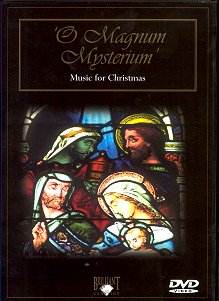
I think that the title
of this DVD is a bit misleading. The
contents of the first half, comprising
German and Italian baroque items are,
if not specifically Christmas music
in every case, at least music that can
legitimately be connected with that
festival. On the other hand, with the
exception of his specifically Christmas
motets, none of the Poulenc pieces has
any such seasonal connection. In fact,
what we seem to have here is a compendium
of two recitals by the Corydon Singers
that are otherwise unconnected. This
is potentially a trap for the unwary
impulse purchaser.
However, provided those
who buy the DVD don’t mind that it doesn’t
contain Christmas music exclusively
there is a good deal to enjoy. In particular,
this is an opportunity to hear Matthew
Best and his fine choir in music, which,
so far as I am aware, is otherwise absent
from their extensive and consistently
excellent discography.
We may well be living
in a golden age of choral singing for
there is an abundance of excellent chamber
choirs currently before the public (in
many cases the personnel is interchangeable,
of course.) Among such groups the Corydons
must be counted among the very finest.
I’ve got many of their CDs in my collection
and have also been lucky enough to experience
them in concert a few times. Never have
I been disappointed. I think part of
the reason for their excellence may
lie in the fact that their conductor,
Matthew Best, is himself not only a
fine and experienced singer but also
pursues a very active and successful
career as a soloist. (Only a few weeks
ago I heard him give an exceptionally
fine performance in the role of Judas
in the centenary performance of Elgar’s
Apostles in Symphony Hall, Birmingham.)
Clearly Best knows the art of singing
expertly and from the inside. He uses
that knowledge to get excellent results
from his singers.
It was only while watching
their Poulenc performances here that
another thought struck me. I may be
wrong but I wonder if there’s a slightly
wider age range in this choir than is
the case with similar, rival ensembles?
Most of the expert professional choirs
on the circuit these days seem to include
a predominance of young singers who
bring great freshness to the sound.
Many such singers are present in the
ranks of the Corydons but there are
also quite a few who are a bit older.
This combination, I suspect, helps to
produce the full toned yet bright edged
sound characteristic of the choir.
In the baroque part
of the programme the choir is joined
by His Majesty’s Sagbutts & Cornetts
who provide sonorous support, playing
their period instruments, which are
fascinating to see. The first and last
items in this part of the programme
are, in fact instrumental. I thought
the piece by Scheidt was more interesting
than the Canzon by Marini. The Magnificat
by Praetorius is a splendidly festive
offering. In between the verses of the
canticle itself the composer inserts
verses from old German carols. There’s
a verse from Josef lieber, Josef
mein and all the remaining interpolations
are verse of In dulci jubilo. It’s
a most enjoyable piece, winningly performed
here. Rich sonorities predominate but
Best ensures that the rhythms are well
sprung so there’s no feeling of heaviness.
One slight snag is that here and elsewhere
the contributions of counter-tenor Angus
Davidson don’t always cut through the
texture. We can see he’s singing but
sometimes we can’t hear him properly,
which is a pity.
The visual presentation
allows us to see the different forces
required and the varying ways in which
they are deployed in the baroque items,
especially those by Gabrieli His O
Magnum Mysterium is given with the
right degree of awe-struck mystery.
The following Salvator Noster
features some particularly effective
florid accompaniment from the instrumentalists.
The Poulenc items were
filmed in a different location and a
slightly more resonant acoustic. Two
of the selections call for smaller groups
of singers. A group of men sing the
Prayers of St. Francis, exquisite
but rather austere settings. The singing
here is as splendid as elsewhere in
the programme. There’s a firm bass foundation
and an excellent, ringing tenor line.
The singers’ French is very good. A
small group of the ladies also have
an item to themselves in the shape of
the Litanies to the Black Virgin
[of Rocamadour]. This is also sung in
French and the singing strikes me as
being supple and dedicated.
The remaining items
use full mixed choir and I was interested
to see that in these items Best uses
a larger group of singers than anywhere
else on the DVD. The devoted and sophisticated
Salve Regina is well communicated
(what a wonderful, unexpected harmonic
sequence Poulenc employs on the very
last word of all, "Maria"!)
The ebullient Exultate Deo brings
the proceedings to an emphatic close.
Earlier Best and his singers perform
Poulenc’s Christmas motets. The more
I hear these four exquisite miniatures
the more I think they are, perhaps,
the finest music that the French master
wrote. It’s such wonderful, luminous
music. The best of all, I think, is
the opening O Magnum Mysterium. Here
the heavenly melody is floated seraphically
by the Corydon sopranos, just as it
should be. Later the tenors distinguish
themselves with some lovely, sappy tone.
In fact, the tenor line is crucial to
Poulenc’s textures throughout these
motets and the Corydon tenors never
let him down. The other three motets
come off equally well. The concluding
Hodie Christus natus est features
some finely disciplined rejoicing.
Throughout the whole
programme, the performances are presented
"straight" in the sense that
what we see is a visual representation
of a concert performance with no illustrative
shots of, say, the venue. If this sounds
like a recipe for dull viewing, it’s
not, for throughout the DVD there’s
a good but never distracting variety
of camera shots. In the baroque section
I thought that sometimes the film track
was minutely out of synchronization
with the soundtrack but this isn’t a
major distraction and there’s no such
issue in the Poulenc items. Heard through
my television set the stereo sound seemed
perfectly satisfactory.
The presentation is
pretty basic. As you might expect with
a budget priced DVD there are no extra
features. The documentation is shoddy,
I’m afraid. There are no notes and though
texts are provided this aspect is downright
slipshod. For a few items both the texts
and English translations are supplied
but in the case of the Poulenc Christmas
motets, all of which are set in Latin
the Latin text of one is supplied while
for the other three only a French text
is supplied.
The performances are
the main thing here and since these
are uniformly excellent this DVD can
be recommended.
John Quinn
 Simon Over (organ)*
  BRILLIANT
CLASSICS 6468 [72’15"]
BRILLIANT
CLASSICS 6468 [72’15"]