AVAILABILITY
www.biddulphrecordings.com
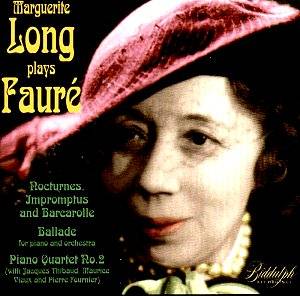
One of the most prestigious
figures in French pianism, Marguerite
Long was a formidable presence at the
Paris Conservatoire. The extent to which
she could legitimately claim authority
in certain works has been a moot point
for many years but this Fauré
selection allows us the opportunity
to judge her contribution to the literature
in the round, as chamber colleague,
with orchestra and in the solo literature.
The Piano Quartet in
G minor is a wartime recording – and
I believe it took place around the time
that Thibaud’s son was killed in battle.
His colleagues were the leading French
violist, Maurice Vieux (what a Sinfonia
Concertante they would have produced
together), and Pierre Fournier. Thibaud’s
very precise downward portamenti are
entirely characteristic and bewitching,
though his tone lacks the fuller weight
of his recordings in the 1910s and 1920s.
Though at some moments one may be inclined
to doubt it, the tonal unanimity in
unison string passages is still entirely
convincing and the performance sensitively
shaped, the Scherzo being especially
fluent and fast before it sinks into
a veil of impressionism, illuminated
by Vieux’s tortuous viola line. In all
this Long plays her part but in the
Adagio one can detect a certain hardness
in her tone, certainly in comparison
with the string statements; she’s also
quite straight in her phrasing, and
not quite on the same level of nuance
or subtlety as her colleagues. But she
does much better in the finale where
her bustling vigour adds to the impatient
drive and triumphant direction of the
music.
It’s interesting to
listen to Gaubert’s direction of the
Ballade, one of the few works by Fauré
for which I have little time. The mass
portamenti and limited vibrato of the
orchestra of the Société
des Concerts offer a window into performance
style in Paris c.1930. The solo works
offer rather greater musical value.
The F sharp Impromptu is athletic and
crisp with fine voicings whilst the
sixth Barcarolle is full of affectionate
charm. Her E flat Nocturne (No. 4) is
certainly individual. It’s brisk and
determined with little lyrical breadth
and some strange rubati. There’s plenty
of style, certainly, and an assurance
that borders on aggression. But as the
Testament releases of the magnificent
cycle of Fauré recordings (transferred
from Ducretet-Thomson LPs from the early
1950s) by Germaine Thyssen-Valentin
have shown there are more ways of playing
him than Long is prepared to countenance.
Thyssen-Valentin’s is an immeasurably
more convincing and subtle reading and
as the Sixth Nocturne shows sometimes
Long is guilty of rather mechanistic
phraseology, lacking intimacy. We end
with the delightful Vallin-Long reading
of Les Berceux.
The notes concentrate
rather more on the music than the musicians
but the transfers are generally good.
There’s quite a bit of surface noise
retained on the Sixth Nocturne and on
the Quartet generally but I can well
imagine that the shellac was somewhat
compromised. It’s an admirable selection
of Long’s work and though I do find
her uneven and occasionally problematic
her recordings deserve a place on the
shelves of anyone devoted to Fauré’s
piano music.
Jonathan Woolf
 Ninon Vallin (soprano)