Of
the many Italian composers of keyboard music around 1600, Ercole
Pasquini is one of the least known. Even the dates of his birth
and death are a mystery. By the middle of the 1580s Pasquini was
active in Ferrara, which was then one of the centres of musical
activity in Italy: Luzzasco Luzzaschi was organist and maestro
di capella, and the 'Concerto delle Donne' was drawing wide attention,
including that of composers like Dowland, de Wert and Merulo.
In 1594, Pasquini contributed a poetical work, 'I fidi amanti',
to the wedding of the Duke of Ferrara's niece to Carlo Gesualdo,
prince of Venosa, who stayed there for two years. In 1597 Pasquini
went to Rome where he became organist to the Cappella Giulia at
St Peter's. But after the turn of the century he became insane
and was therefore dismissed as organist in 1608 and succeeded
by Girolamo Frescobaldi.
During
his period in Ferrara, Pasquini must have gotten to know the musical
language of Carlo Gesualdo, with its strong dissonances and frequent
chromaticism. But although Pasquini certainly comes up with some
harmonic surprises, he is rather restrained compared to younger
contemporaries. The strongest dissonances and harmonic adventures
can be found in the Toccatas and in the 'Durezze e ligature',
which were specifically meant to be played at the organ. In other
works he concentrates less on a display of virtuosity than most
of his colleagues. In the passaggi on De Rore's madrigal 'Anchor
che col partire', for instance, the melodic character of the original
always holds the upper hand.
It
has to be said, though, that the harmonic surprises are sometimes
a little underplayed here, in particular in those pieces which
are played at the harpsichord. One of the reasons is the fact
that chords are frequently played as arpeggio. Since the sound
of Italian harpsichords dies down pretty quickly, the harmonic
characteristics of the chords aren't always fully revealed. But
at the organ, arpeggios don't work; the harmonic boldness is more
strongly displayed here. I would also have preferred a faster
tempo now and then, and more dramatic pauses occasionally.
But
I am very thankful to James Johnstone, who had the great idea
to devote an entire disc to the works of this neglected composer.
Having heard his music I can only conclude that this neglect is
unjustified. And despite my criticisms, I thoroughly enjoyed the
interpretation by James Johnstone, who uses a fine Italian harpsichord
of 1677 from the collection of Kenneth Gilbert, and an organ built
after a historical positive organ from Lucca. The recording is
pretty close, but after some time one gets used to it.
I
strongly recommend this recording which colours a white spot on
the map of Italian music history.
The
"S" in the list of works is nowhere explained, but I gather it
refers to William R. Shindle's publication of Pasquini's 'Collected
Keyboard Works' from 1966. I also assume that the parts of the
titles between brackets don't appear in the manuscripts.
Johan
van Veen
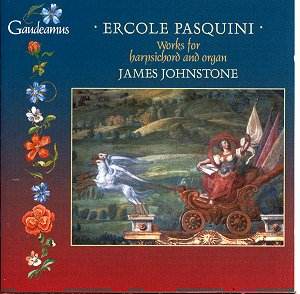
 James Johnstone, harpsichord,
organ (*)
James Johnstone, harpsichord,
organ (*)