A
precocious student of Rimsky-Korsakov, Glazunov was probably the
last of the established composers from the Russian 19th century
School. His music which continued the tradition of Tchaikovsky
quickly became unfashionable and out of step with the progressive
musical developments from composers such as Stravinsky, Richard
Strauss and his pupil Prokofiev. Viewed a century or so later
Glazunov’s style is no longer a barrier to a fuller appreciation
of his music.
The
Triumphal March which has an optional choral part, comes
across as an unlikely fusion of late-romantic Russian and the
quirky American Charles Ives. Composed for the Chicago Exhibition
in the USA, the work includes the popular song ’John Brown’s body’
Glazunov provides lots of employment for the brass and percussion
sections, sounding like closing scene from a ballet score.
The
two short Serenades are appealing orchestral scores which
use pseudo-oriental melodies in a manner that was fashionable
at the time and used by his compatriots Rimsky-Korsakov and Balakirev.
It
is a shame that the two substantial Overtures on Three Greek
Themes are not better known. Either of the two works would
make a welcome change to commence an orchestral concert, instead
of the more usual overtures from Rossini and Mozart et al.
Not
dissimilar to the two Serenades there is a contrived aroma
of the middle-eastern exotic blended together with much use of
the woodwind, brass and percussion; which is so typical of Glazunov’s
writing.
It
is generally agreed that the best of Glazunov’s music is to be
found in his ballets. Raymonda and The Seasons are
clearly the most popular but Les ruses d’Amour and the
orchestral ballet suite Scènes de ballet deserve
to be heard more. The orchestral suite Chopiniana, which
Glazunov later fashioned in the ballet Chopiniana (more
popularly known as Les Sylphides in European ballet circles)
was selected, arranged and orchestrated from Chopin piano works.
Chopiniana
displays Glazunov’s brilliance at orchestration and conductor
Vladimir Ziva effortlessly and and with accomplishment brings
out the wide range of colours and blends together the movements
with a continuity that has been so often lacking in alternative
versions. For some years I have been playing the eminent recording
of the suite played by the USSR Symphony Orchestra, under Evgeny
Svetlanov, on BMG/Melodiya 74321 59055-2. Maybe not as polished
as the Melodiya release I feel that this Naxos recording is played
with more vigour and excitement and gets further inside the spirit
of the music.
Throughout
the disc the Russian Symphony Orchestra play with immediacy and
an abundance of passion, offering a genuine empathy for the music
of their fellow-countryman. Especially fine is the expressive
and well-tuned woodwind which immediately attracted my attention
in these wonderfully late-romantic Glazunov works.
Perhaps
a touch more rehearsal time may have improved one or two rough
edges but the numerous plus-points certainly outweigh in a sterling
performance. I love the way Maestro Ziva builds and achieves the
many exciting orchestral climaxes in the scores with a real control.
The
Naxos sound engineers have produced a warm and clear recording
with a lovely balance.
Russian
music passionately played with boundless energy and bristling
with character. A most convincing recording which would be my
top recommendation even at full-price.
Michael
Cookson
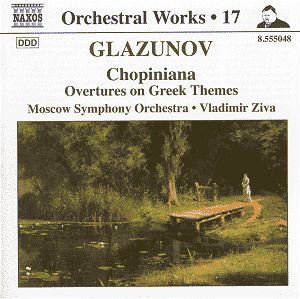
 Moscow Symphony Orchestra/Vladimir
Ziva
Moscow Symphony Orchestra/Vladimir
Ziva