Mendelssohn followed the trend of many of his contemporaries
- Liszt and Berlioz, for instance - by responding to the creative possibilities
offered by literary and pictorial sources. The Overture was therefore
an important type of composition for him, gaining an independence away
from the context of preceding an opera or other stage work.
While this interest in the concert overture is certainly
the general trend in Mendelssohn's approach, the Overture to Victor
Hugo's drama Ruy Blas has definite links with the theatre, even
if it has subsequently achieved an independent status in the concert
hall. So too, of course, the link with Shakespeare's Midsummer Night's
Dream, though in that case the incidental music for the theatre
followed the original concert overture by a distance of 17 years. Not
that the listener would discern this from the music.
Of all composers Mendelssohn was surely the greatest
prodigy as a teenager, this overture and the Octet the supreme examples
of his youthful genius. However, it is wrong to dwell on the fact that
this music was written by so young a composer, since that deflects us
towards astonishment at his precocity, when we should be concentrating
on the extraordinary nature of the music itself.
The translation of Shakespeare was one of the most
significant literary developments in Germany during the first half of
the 19th century, capturing the imaginations of writers, artists and
composers alike. The Overture and Incidental Music to A Midsummer
Night's Dream are the quintessential example of Mendelssohn's 'fairy
music', and therefore the score poses particular challenges to the performers
even today, in terms of dexterity and intonation and style.
John Nelson and his Parisian forces respond with enthusiasm
and consummate skill. The conductor has centred much of his career in
France and is a noted Berlioz interpreter. He also knows his musicians
and directs them with rare sympathy. The sparkling performance of the
Overture reflects all this, helped as it is by a clear and atmospheric
recording. Tempi and articulation are beautifully judged.
These features are carried over into the succeeding
Scherzo (another tour-de-force of 'fairy music', and into the other
items which follow. Some are substantial movements, whereas others are
shorter and serve in close tandem with scenes from the play. It is here
that the special nature of this recording comes in, since extracts of
the play are used in combination with the music. The vocal projections
are clear in enunciation, and the pacing of music and drama is well
directed and therefore effective. If there is a criticism to be made,
it is in the organisation of the cue points and spacings relative to
these things; sometimes the words begin immediately upon the music,
making it hard for the technically inclined listener to programme his
CD player to his preference.
Mendelssohn was commissioned to write the music for
Ruy Blas in 1839, in connection with a Leipzig production of
the play. This typical Hugo tragedy, with passionate emotions and irreconcilable
conflicts, was 'cordially disliked' by the composer; but that did not
prevent him from creating one of his most stirring and effective orchestral
works, whose stature is apparent from the initial sonorous chorale statement,
setting the tone for the whole. This dramatic rendition completes this
most appealing new issue, a splendid addition to the catalogue.
Terry Barfoot
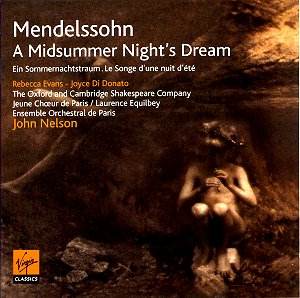
 Ensemble Orchestral de Paris/John
Nelson
Ensemble Orchestral de Paris/John
Nelson