I am pleased to welcome this disc as I was very impressed
with its predecessor (Symphonies 6 and 7, reviewed in June 2001). This
is Volume 2, so I hope I haven’t missed any further releases in this
series. A co-production between Dacapo and Danish Radio, the recordings
are models of their kind: clear and detailed and well balanced by the
sound engineers.
Are these symphonies as interesting to listen to as
their later cousins? I think yes. Both are in the common three movement
configuration which many Scandinavian composers use for this form of
composition. The First Symphony is known as an apprentice work. Initially
both this and the second symphony were forbidden by the composer to
be performed.
Herman Koppel had been an admirer of the works of Carl
Nielsen and in 1929, Nielsen wrote a recommendation - "The young
artist Mr. Herman Koppel, has already, as both pianist and composer,
revealed such uncommon abilities that it is a pleasure for me to give
him my warmest recommendation. Mr. Koppel, who has now concluded his
four year course, has been a great asset to the Royal Academy during
these years, and I am convinced that a study trip abroad at this point
would be of the greatest importance to his further artistic career,
in view of which I yet again give him my best possible recommendation
and good wishes on his way."
This recommendation allowed Koppel to travel to Germany
for a course of study, primarily in Berlin where he spent his time composing
and attending concerts. This symphony was completed during this period,
and received its first performance on 23rd February 1931 by the conductor
Emil Telmányi in the society Dansk Koncertforening. It
was broadcast live on radio. In Koppel’s own words the first performance
was "a crashing failure", and the symphony received harsh
words in the newspaper reviews. It was seen as derivative: more Nielsen
than Koppel. The composer was very disappointed with the work’s failure,
and forbade further performances.
The Second Symphony was the first of a series of three
"war symphonies" and was written in 1943, when Denmark had
been under Nazi occupation for about three years. This would be about
six months before the Jewish persecutions lead the composer into exile.
This work is much longer than the First Symphony, running to almost
41 minutes. The first movement begins with a very beautiful cantabile
theme on bassoon and celli. This becomes animated with the second subject
on the violins and leads to a forceful climax. The themes of this are
further reworked in the development and the movement ends with a fugue
accompanied by trombone as a cantus firmus. The second movement
is marked molto expressivo, and is the most serious of the three.
The third movement opens with an elegiac passage and the resulting peaceful
atmosphere is soon shattered by a violent march which begins the main
part of the movement. This finishes unresolved with a question mark.
The symphony, dedicated to his wife, was given in the
Tivoli Concert Hall, Copenhagen, and although not receiving the artistic
savaging of its predecessor, also disappointed the composer who later
deleted it from his list of compositions without returning to it again.
Dacapo is to be congratulated on having the courage
to record two such works. Now, in the fullness of time, they don’t sound
nearly as bad as seems to have been thought at the time. Given the advocacy
of orchestra, conductor and recording engineers, this issue deserves
a wide circulation – I liked it very much.
John Phillips
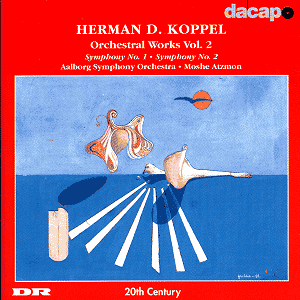
 Aalborg SO/Moshe Atzmon