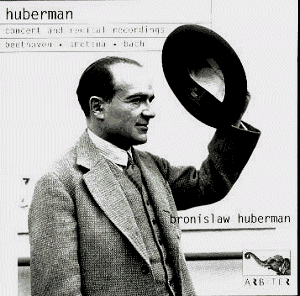
The second volume devoted to Huberman in Arbiter’s
engrossing series includes a substantial first release. The 1944 Beethoven
Concerto dates from his sixty-second year and shortly preceded his early
death – he died in 1947 aged sixty-five. It must now also take its place
alongside the decade earlier commercial Columbia recording with George
Szell conducting the Vienna Philharmonic Orchestra as a means by which
to judge Huberman’s classicist credentials, with the increased frisson
of a live performance. Huberman’s oratorical grandeur and his philosophical
depth are shown in all their richness and animation in this dramatic
traversal. His dry tone, unwarmed by continuous vibrato usage, is both
an anachronism in matters of twentieth century tonal development and
also, ironically, a beacon for and presage of contemporary iconoclasts
as, for example, Gidon Kremer.
Huberman’s broken octave entry is a locus classicus
of his expressive style; it’s quick and intensely dramatic but tonally
it is to modern ears inconsistent, with a bleaching effect caused by
on/off vibrato usage. Nevertheless the powerful current of his articulacy
is best measured by noting where the weight of his vibrato intensification
falls, by analysing the phrasal rise and fall, its lyric phraseology.
His lower two strings are especially unwarmed and this contributes to
some of the passagework sounding – to coin a word of William Primrose’s
– "scratchy" (an adherent of Ysaye and subsequent embracer
of the Russian school such as Primrose would never have countenanced
the anachronisms that Huberman so self-evidently displayed). Huberman’s
portamenti are prominent but intensely expressive when employed – and
in doing so he sometimes employs a portamento with an audible intermediate
note, just one of several portamenti an elite player can employ. He
plays the Joachim cadenza with tremendous drive and drama. The horns
aren’t ideally secure in the opening of the second movement – in the
same way that the oboe and winds had made their idiosyncratic weight
felt in the opening movement. But Huberman is secure in terms of intonation
and his profile here is seraphic albeit whilst the metrical flexibility
is intense there are still signs of slightly forced or italicised phrasing.
It is noteworthy how expressive his playing can be without resorting
to ostentatiously overt vibrato usage. Barzin and Huberman launch the
finale with real theatrical bravado. If the violinist’s vibrance is
decidedly limited he dances and spins over the bars with decided brilliance
and if the cadenza is not entirely secure and there remains a lack of
opulent potential and colouristic projection, he lacks nothing in drive
and punch. I must admit that his dead sound can be off-putting – the
pre-Kreislerian aesthetic was much more austere and steely – but that
his conception is intensely involving and my objections and criticisms
are generally subsumed into musical admiration.
The two movements from the Kreutzer Sonata are
unpublished takes from the commercial London recording of 1930. I’ve
always found his huge downward portamenti in the opening of the first
movement to be as intensely provocative, as part of a musical argument,
as the rather austerely snatched phrasing. His passagework positively
crackles and Friedman is a worthily combustible partner, both men in
regally driving form; the reappearance of that immodest portamento at
the end of the movement is part and parcel of Huberman’s expressive
symmetry. The differences however between this and the published take
are minimal as is the case in the finale of the sonata, where Friedman’s
bass pointing makes itself exquisitely apparent. The Smetana suffers
from some acetate wear but as a performance is full of affectionate
drive and not heated artificially at the climax as it all too often
can be – an additional pleasure is that he never recorded it commercially.
The Bach is incomplete unfortunately – he’d recorded it commercially
for Columbia in 1935 – but was a favourite Chorale Prelude of Huberman’s
and he plays it with rapt devotion if again with idiosyncratic tonal
resources.
Once again this is a release of considerable distinction.
Huberman was an endlessly fascinating, endlessly provocative violinist
and his legacy’s expansion in the past few things has been a source
of admiration and excitement to his still legion of admirers amongst
whom, even doubtfully, I register myself.
Jonathan Woolf
 Ignaz Friedman (piano) in
the Kreutzer Sonata – previously unissued takes of the commercial recording
made in London in 1930
Ignaz Friedman (piano) in
the Kreutzer Sonata – previously unissued takes of the commercial recording
made in London in 1930