Naxos continue their exploration of the first ever
cycle of the Beethoven Symphonies undertaken by one conductor – albeit
one that came about as much by default, re-recording and opportunism
as by foresight. Weingartner’s first recordings in the cycle came in
1923 (though he’d recorded much earlier still, as a piano accompanist
to his then wife) but the earlier acoustics were generally supplanted
in time by electrics from 1926 onwards. There were multiple recordings
therefore of some but only one recording of the Pastoral and
the Fourth. The Eroica displays many of Weingartner’s greatest
strengths; the opening has a splendid drive - virile, lithe with clear
accents, precision of chording and little variation in tempi. He is
wise over distinctions between sforzati and equally so in terms of the
trajectory of the movement as a whole. The funeral march however is
the movement that will encourage most debate because here, famously,
Weingartner ignores the stricture he himself made in his book on the
performance of the Beethoven symphonies. The movement is certainly one
of great (but typically not grandiose) nobility and restraint, the clarinet
singing out with affecting depth, balance between string choirs splendidly
maintained. But whereas he counselled specifically against hurrying
at bar 69 et seq here he does pretty much precisely that – as he does
in the fugal section – and he ignores his earlier stern suggestion of
crotchet = 66-72 by taking it at something more like 56-96, thus subjecting
the movement to far wider tempo extremes than one would otherwise have
expected of someone’s of Weingartner’s assumed sobriety. Whether one
accepts his solution is an individual matter – and it goes, presumably,
to show that prescriptive concordats are modified over time and through
experience. Very few things are writ in stone. The scherzo though is
wonderfully animated and the Finale splendid – crisp and dramatic.
The Fourth was recorded a few years earlier with Beecham’s
new LPO and I can recommend it unreservedly as an example of Weingartner’s
sagacity. There is gravity in the opening followed by excellently graded
string tone, the winds moulded with a degree of plasticity that never
becomes lax. The Adagio develops an organic life, the bass line firm
but not cloying or clogging – mobility is the aim – and the ebullience
of the Scherzo is palpable, sprung with delicious weight, moving forward
with real drive (see the almost contemporaneous recording by Erich Kleiber
which is consistently slower than Weingartner for the first three movements
before it unleashes a bullet of a finale). Weingartner in fact observes
the ma non troppo direction for that Finale – adding witty exchanges
between the crisp and vibrant strings, wind and the running double bass
line.
Restoration by Mark Obert-Thorn, which is good, includes
some added reverberation in the Fourth – he cites the original pressing
as having been boxy. I’m not otherwise greatly in favour of this but
it has been done discreetly here.
Jonathan Woolf
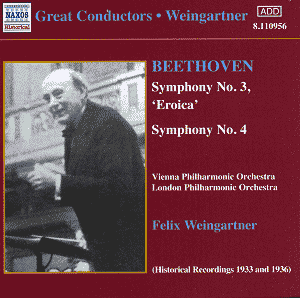
 Felix Weingartner