The Lindsays already have a Beethoven cycle under their
belt from the 1980s, and very recommendable it still is, especially
at lower mid-price. This new, ongoing digital cycle appears to be building
on their earlier achievements, with the attributes that marked out those
performances very much in evidence – tonal strength, concentration,
a refusal to sentimentalise the music – but now with added insight drawn
from living with this great music over many more years.
The sheer force and power of the readings is obvious
from the imperious unison opening of Op.95, one of the most commanding
starts to any Beethoven work. Indeed, as Richard Wigmore’s highly informative
insert note tells us, this is one of the composer’s most violently concentrated
movements, "a high-pressure sonata drama that packs an astonishing
amount of activity into a mere four-minute span". This is true
of the whole work, and it shows a composer having no truck with conventional
transitions, neat cadences or ‘safe’ modulations; the key changes are
sudden, sharp shocks which the Lindsays bring out with suitable abandon,
even roughness. There is no lack of blend, of course, but occasionally
their sheer involvement in the drama gives the music a raw edge that
I find appropriate. If one turns to other full price rivals (I happened
to have the Tokyo Quartet’s cycle, on RCA, to hand) one encounters a
smoothness and richness that has its own rewards, but misses something
of the danger in the music. A good comparison can be made with the two
finales, where I feel the Lindsays just have the edge in bringing out
the turbulence and abruptness that so characterises the piece. The Tokyos
are superb in the shimmering F major coda (around 3’45), but the Lindsays
are determined to make the most of the almost comic send-off that the
work gets, where Beethoven gives us, to quote Wigmore, "not so
much a typical resolution as an airy denial of the pain and violence
that have gone before". Just so.
The magnificent follow up to this work is one of the
great chamber music statements, even by Beethoven’s standards. Op.127
came a full twelve years after its predecessor, and has a profundity
that has brought out the best in string quartet ensembles over the decades.
The sonorous, almost organ-like opening chords that set the great journey
in motion, are beautifully voiced by the Lindsays, and give us a glimpse
of the strengths (and occasional weaknesses) on this performance. The
raw vitality that characterised Op.95 is still there, and is heard at
its best in the marvellous third movement scherzando vivace,
where the refusal to smooth out the lines pays dividends. Only in the
great variation-form adagio do I miss the level of profundity
on offer elsewhere, most notably (to my ears, at least) in the Talich
Quartet’s traversal on Calliope. It’s a subtle thing, but a good example
occurs around 10’15, where Beethoven conjurs up a strange, spare-textured
variation in D flat minor (notated for convenience as C sharp minor)
that the Talich’s play as a rapt meditation, a spiritual prelude before
the dance-like final variation. This level of insight is just missed
by the Lindsays, but other compensations, such as better tuning and
a less close-up balance, do tend to make amends.
If you are a dedicated follower of the Lindsay cycle,
you will not be disappointed. The recording is excellent, spacious and
detailed, and the liner notes a model of their kind. There is a great
deal of competition in this repertoire, some of it (like the excellent
Italian Quartet, on Philips Duo) at mid and budget price. But the Lindsays
are now among the finest ensembles before the public, with a deep understanding
of this music and a maturity that has grown with the years. Their playing
can withstand the severest of comparisons, and buyers new to the repertoire
but wanting bang up to date sound quality, can certainly purchase with
confidence.
Tony Haywood
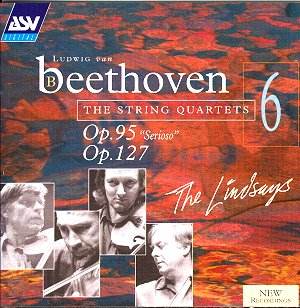
 The Lindsays