Ambition
is a two-edged sword. Certainly, as Browning’s Andrea del Sarto
inimitably put it, "a man’s reach should exceed his grasp,
or what’s a Heaven for?" Yet when the grasp is as weak as
Ruperto Chapí’s in his last attempt at reaching for the
elusive Heaven of Spanish Opera, the attempt is not uplifting.
The effort of writing Margarita la tornera may have hastened
the composer’s death, a bare month after the 1909 premiere. As
for the effort of listening to it ... válgame Dios!
The
scenario is potent. The nun Margarita, tornera (doorkeeper)
of a convent in Palencia, is seduced by our old friend Don Juan,
who is soon off after another conquest, the worldly dancer, Sirena.
Margarita selflessly defends him, allowing him to escape from
justice after wounding Sirena’s current lover at a party. Returning
to Palencia two years later, she rejects her now-chastened lover
once and for all, and entering the convent miraculously finds
"Margarita la tornera" apparently still in her place
- it is the Virgin herself, who has answered Margarita’s prayers.
As in Chapí’s zarzuela grande, La milagro de
la Virgen, where the heroine’s horrific earthly tragedies
are finally revealed as a dream, Margarita is not so much
redeemed from sin as simply wiped clean. The subtext raises questions
about the worth of abstinence over indulgence, of innocence over
experience, of spiritual over earthly passion.
The
devil tempts me to spend time dissecting Luis G. Iberni’s deeply
stimulating and persuasive programme-note (well translated into
English by Yolanda Acker) rather than Chapí’s music itself.
Iberni is absolutely right to attack the age-old ‘spin’ that Spanish
music somehow begins and ends with the work of Pedrell and his
great pupils Albéniz, Granados and de Falla. The zarzueleros
from Barbieri and Gaztambide onwards are important musical figures
in their own right, whose work needs no special pleading - merely
regular performance.
He
starts, though, with the affirmation that "Chapí
... is undoubtedly the most important Spanish composer of stage
music of all time." Fighting talk! If sheer quantity,
technical know-how and stylistic range are his criteria, it’s
difficult to argue. But the range of Iberni’s stylistic references
- Puccini and verismo, Ponchielli, Wagner, Berlioz, Saint-Saëns,
Richard Strauss - gives a fairer picture of Margarita’s
problem than his quixotic thought that, had Chapí not died
when he did, "it is very likely that his career wouldn’t
have been very different to that of Janáček,
the only European composer of his generation who meets his standards
in regard to theatrical music”.
One
thing Janáček had, even as a clumsy young tyro, which Chapí
did not - an individual voice. Despite his theatrical intelligence,
harmonic-contrapuntal sophistication and orchestral brilliance,
this particular Chapí score is pretty much dead in the
water. Even in a heavily compressed stage version such as we have
here, the pervasive lack of thematic distinction is impossible
to disguise. There are some effective moments, such as the magic,
shifting harmonics of the descending string theme associated in
the outer acts with Margarita’s prayers to the Virgin, or the
lucid sequence of woodwind arpeggios signalling the miracle itself;
but nothing strikes deep. Most of the score is just efficiently
emotive, no better or worse than those forgotten French and Italian
operas of the day which Margarita so closely resembles
in formal and melodic cut.
Iberni
points to the one outstanding number, the seductive, Andalusian
Zaraband led by Sirena in the party scene of Act 2, as evidence
of a strong influence on de Falla’s Spanish style. But it’s worth
pointing out that the first version of La vida breve was
written five years before, under the influence of Giménez’s
La tempranica (both had also been to Carlos Fernández
Shaw texts.) Chapí was a consolidator, and the historical
debt owed him by Spanish music is indeed great; but his worth
today as a composer is better measured by his chamber and orchestral
music, or by the concentrated inspiration of the best zarzuelas
such as La revoltosa, La bruja and (reputedly) Curro
Vargas, than by this ambitious but lacklustre score.
Margarita’s
is the central consciousness, and Elisabete Matos copes valiantly
with the length and difficulty of the role. Her involvement in
the last act, with its earthly rejection and miraculous apotheosis,
almost carries the day. Plácido Domingo is a modern miracle
on his own, a little thinner in tone than of yore, but still beautifully
focused and controlled. His portrait of Don Juan is sympathetic
and passionate enough to make Margarita’s choice a real and painful
one.
Ángeles
Blancas delivers her hit number with seductive steel, though Sirena’s
worldly call is limited by the swingeing cuts. Only Stefano Palatchi’s
Leporello-equivalent falls short, sung with unremitting heaviness
- though in fairness Chapí saddles Gavilán with
much of the most earthbound music. The late García Navarro
leads his forces with such authoritative conviction that it’s
impossible to think Chapí could have had better advocacy
in the pit. After all is said and done, this is a set which anyone
interested in Spanish theatre music ought to hear, especially
when the performance itself is so urgent and direct. Just don’t
expect ambition to reach to a revelatory masterpiece.
Christopher
Webber
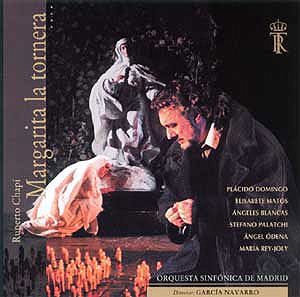
 Margarita - Elisabete Matos;
Don Juan - Plácido Domingo; Gavilán - Stefano Palatchi; Don
Lope - Ángel Ódena; Sirena - Ángeles Blancas; "La
tornera" - María Rey-Joly
Margarita - Elisabete Matos;
Don Juan - Plácido Domingo; Gavilán - Stefano Palatchi; Don
Lope - Ángel Ódena; Sirena - Ángeles Blancas; "La
tornera" - María Rey-Joly