These recordings were originally issued in the
early 1990s on the Erato label, in a series which included the
other three symphonies and various shorter orchestral works. Competition
is intense in this area, of course, from both modern and historic
issues, but a reissue of a reading by as significant a musician
as Daniel Barenboim is not to be lightly dismissed.
The orchestral playing from the unsurpassed Chicago
Symphony is of the very highest standard, and they follow Barenboim
all the way through his sometimes wilfully flexible account of
this great masterpiece. As far as the interpretation goes, I feared
the worst during the slow introduction; I didn’t think I was going
to enjoy the performance much, because Barenboim’s mannerism of
adopting the slowest possible tempo, and then slowing up even
more at the end of all phrases and at the approach of each and
every cadence is much in evidence here, so that the music struggled
to get going.
But, once we get into the Allegro, things
got better, and Barenboim and his players deliver a powerfully
dramatic account. In particular, the mounting climax, starting
low down in the contra-bassoon and culminating with the recapitulation
of the first subject, is superbly controlled and overwhelming
in its impact.
The slow movement is marked Andante sostenuto,
and some listeners will feel that Barenboim overdoes the sostenuto
and lingers a little too lovingly. But the phrasing is very
beautiful, and this movement must not at any cost be hurried.
Woodwind solos, in particular from the principle oboe, are elegantly
expressive, and the contributions from the leader (sadly uncredited)
are beautifully played.
The Un poco allegretto third movement
is an original and very Brahmsian concept, with relaxed, serenade-like
outer sections flanking a vigorous central scherzo, where it was
good to hear the important details of trumpet writing coming through
so clearly. The dark slow introduction to the finale takes us
back to the tragic world of the symphony’s opening, and also,
unfortunately, to Barenboim’s tendency to exaggerate contrasts.
The transition, with its horn and flute solos, is handled superbly,
but the opening of the Allegro non troppo, ma con brio,
with the entry of the great C major theme, is curiously diffident,
and is followed by a misjudged precipitous rush into the ensuing
tutti. Then, when we return to the ‘big tune’ at the start of
the development section, it is uncomfortably hurried; not sure
what Barenboim was doing here. I don’t think it’s a problem caused
by different takes, as it sounds intentional, yet it doesn’t ‘work’
– not for me anyway.
The turbulent climax of the development is done
with conviction, and the return of the dark music of the introduction
has real weight and drama. The re-emergence of the joyful second
subject comes as a true relief, with especially sweet, pure tone
from the Chicago violins. But the coda is disappointing – Barenboim
achieves neither the grandeur of Karajan nor the ecstasy of Toscanini,
mainly because he doesn’t prepare the ground with sufficient care
to create a neutral base from which excitement can grow.
Not an ‘ideal’ performance, then, if such a thing
exists. Yet it is one which is undoubtedly worth hearing, a thinking,
living version, well recorded, and featuring world-class orchestral
playing.
Gwyn Parry-Jones
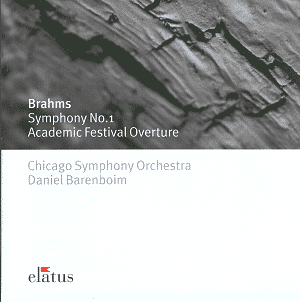
 Chicago Symphony Orchestra/Daniel
Barenboim
Chicago Symphony Orchestra/Daniel
Barenboim