In spite of his full
time career as monk and maestro di cappella
at the Escorial monastery, Catalan composer
Padre Antonio Soler found the time to
composer more than 200 sonatas for harpsichord
as well as many more secular and sacred
pieces. On top of this heavy schedule,
Soler invented a tuning box that he
called a templante and wrote
a controversial treatise on harmony,
"The Key to Modulation". As
with his teacher, Domenico Scarlatti,
Soler is known almost exclusively for
his keyboard music. It is therefore
no surprise that Naxos have recently
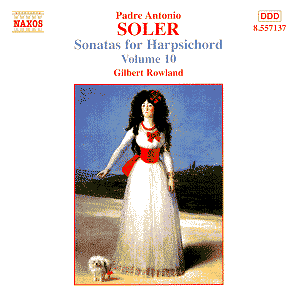
come out with a 10th volume
of his harpsichord sonatas.
A lot is made of Soler’s
tutelage under the master keyboard composer,
Scarlatti. However, there are as many
similarities as there are dissimilarities
in their style, with Soler favouring
the Alberti basses and irregular phrasing
and Scarlatti revelling in acciaccaturas.
In his later sonatas, Soler preferred
three- or four- movement format, with
each movement in the same key, as opposed
to his teacher’s single movement and
paired sonatas. What the music of both
composers shares is stunning virtuosity,
wild syncopations and a rhythmically
energetic Spanish flavour.
One other difference
between the two composers is that Soler’s
sonatas are generally at a more moderate
pace, with only a few in quick tempi.
This is a particularly interesting point
in light of Gilbert Rowland’s momentous
pace. The playfulness of Soler’s sonatas
is sometimes lost in his performance
that is technically flawless but too
rushed to relish. The first track (sonata
in D flat major), for instance, sounds
cluttered because the run of mordent
flourishes has no time to breathe. Interesting
modulations [at 0:33 and 4:25] are also
victims of an unrelenting pace. It might
have been an idea to heed the wise words
of the composer himself,
"What good does
it do if a work is well written but
stirs no feelings in the listener?"
(from The Key to Modulation)
In Rowland’s defence,
this is not Soler’s most inspired composition.
It might have been a better idea to
open with another sonata, such as the
lovely two-movement C minor sonata [tracks
9 and 10]. Neither does the harsh acoustic
help. A softer climate could well have
mitigated the aggressive marriage of
speed and a very busy, ornate texture.
The programme is well
chosen and the sonatas on this record
offer a variety of effects. Sonata no.88
in D flat major [track 2] has some surprising
dissonances (semitone intervals played
simultaneously) and interesting guitar-like
strumming textures. Sonata no.37 in
D major is the most Scarlatti-like,
with triplet figuration against a forward
moving bass line. My personal favourite
is the Allegro from Sonata no.126
in C minor [track 10], which in places
reminds me of the terrifying Schubert
lied "Erlkönig".
A well-rounded CD overall,
encompassing a wide range of moods,
keys and structures. Possibly not the
strongest opening, but don’t let that
put you off. The rest is definitely
worth listening to.
Aline Nassif
 Gilbert Rowland (harpsichordist)