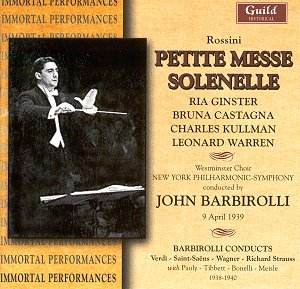
Gioacchino ROSSINI
(1792-1868).
La Petite Messe Solennelle.
Orchestral version
Rina Ginster, (soprano); Bruna Castagna,
(mezzo soprano); Charles Kullman (tenor);
Leonard Warren, (baritone)
 Westminster Choir. New York Philharmonic-Symphony
Orchestra/John Barbirolli
Westminster Choir. New York Philharmonic-Symphony
Orchestra/John Barbirolli
Live broadcast. April 9th
1939
CD 2. ‘BARBIROLLI RARITIES’
Giuseppe VERDI
(1813-1901)
Un ballo in Maschera, ‘Eri
tu?’ (Lawrence Tibbett, bar)
Georges Charles
GOUNOD (1818-1893)
"Ring Out, Wild Bells" (Lawrence Tibbett)
Detroit Symphony Orchestra/John Barbirolli
Live broadcast recording. December 29th
1940
Camille
SAINT-SAËNS (1835-1921)
Samson et Dalila, ‘Mon
coeur s'ouvre à ta voix’ (Kathryn
Meisle, m.sop)
Detroit Symphony Orchestra/John Barbirolli
Live recording 1938
Richard WAGNER
(1813-1883)
Parsifal, Act 1 'Grail
Scene'
‘Mein Sohmn, Amfortas, bist du am Amt'
(Norman Cordon, bass)
‘Nein!... Lafst ihn unenthüllt!’
(Richard Bonelli, bar.)
‘Nehmet hin meinen Blut’ (Chorus)
‘O! Heilige Wonne. Wie hell grüfst
uns heute der Herr!’ (Norman Cordon,
bass)
New York Philharmonic-Symphony Orchestra/John
Barbirolli
Live broadcast recording from Carnegie
Hall. 17 April 1938
Richard STRAUSS
(1864-1949)
Lieder, ‘Verführung’, ‘Gesang der
Apollopriesterin’ (Rose Pauly, sop)
Salome, Final Scene: (Rose
Pauly, sop)
‘Ah! Du wolltest mich nicht’
‘Und deine Zunge’
‘Oh! Warum hast du mich nicht angesehn
Jokanaan?’
‘Ach! lch habe deinen Mund geküsst’
New York Philharmonic-Symphony Orchestra/John
Barbirolli
Live broadcast recording from Carnegie
Hall. February 24th 1938
Bargain Price.
GUILD IMMORTAL PERFORMANCES GHCD 2254/2255
[76.01 and 69.37]
In his background and
recording notes (p 21 of the booklet)
Richard Caniell states, of the Rossini
‘Messe’ that ‘the problems on the original
acetates were so enormous that at first
I gave up all hope of making a restoration’.
He justifies the effort and results
in terms of what Barbirolli achieves
in an electrifying account of the final
movement of the ‘Agnus Dei’ (CD1 tr.13)
Given that this is a performing version
of Rossini’s 1867 orchestral arrangement
of his 1864 original (keyboard accompanied
and more intimate) I am uncertain about
the virtues of that adjective. Rossini
orchestrated his ‘little mass’, as he
nicknamed it in a little pun, on the
basis that if he didn’t do it himself
then somebody else would, and take the
profit! In my view, as one who heard
many Barbirolli concerts in Manchester’s
Free Trade Hall, this issue is ill-conceived.
Whether to restrict the intrusion of
considerable surface noise or keep the
aural distortions to a minimum, the
recording is set at a very low level
and, at times, nearly fades altogether.
A performance of this
work is highly dependent on the singers.
Here, in the ‘Domine Deus’, with its
echoes of ‘Cujus animam’ (Stabat
Mater), the tenor sounds rather bleating
(tr. 4) whilst in the following ‘Qui
Tollis’ (tr. 5) the mezzo is far too
heavy-toned and the soprano has a very
fluttery vibrato. Barbirolli draws excellent
phrasing from the harp and orchestra
but this is a very poorly recorded track
with excessive surface noise. This is
also the problem with the orchestral
‘Preludio Religioso’ (tr. 9) with thin
and wavery strings allied to the extraneous
noises. Given the poor recording quality,
which far too often reminded me of ‘pirate’
LPs, I do not see the value or virtue
of this issue.
In respect of the ‘Rarities’,
as they are titled, on the second CD,
certainly the recorded sound is better,
but there is also plenty of surface
noise to be heard too. Lawrence Tibbett
is full toned and resonant, if a little
stretched by the tessitura of ‘Eri tu’
(CD 2 tr. 1), whilst Kathryn Meisle
is recorded very forward of distorted
orchestral sound (CD2 tr.3). Meisle’s
voice is smooth and resonant with choppy
phrasing and thinning tone as the key
rises. Hers is a voice of no great distinction.
The same comment might also be applied
to the singers in the Wagner (CD 2 trs.
5-9). These are second line house singers
from the ‘Met’. This is not true of
Rose Pauly, born 1894 in Eperjes in
Hungary. She was a leading dramatic
soprano in Europe and the leading Elektra
of her day. Richard Strauss was a great
admirer of her singing but his influence
was unable to prevent the Nazis from
banning her, first from Germany, and
then in Austria. She left mainland Europe
in 1937 and sang at the Met 1938-1940
as well as making acclaimed appearances
in South America and Covent Garden.
Her full-toned singing and expressive
phrasing are heard to admirable effect
in the two Strauss orchestral lieder
(CD 2 trs. 10-11). As Salome she lightens
her tone and gives a fiercely agonised
and dramatic interpretation of the final
scene of the opera (trs. 12-15). There
is little background noise on these
Strauss tracks and the recording is
clear with the voice forward and the
orchestra heard clearly without distortion.
Indeed, the final dramatic chords are
thrillingly caught whilst JB’s conducting
shows his wide experience in the opera
house. Collectors and Barbirolli enthusiasts
must decide for themselves if the virtues
of the Strauss performance justify purchase.
As to the remainder ‘caveat emptor’.
I am sure better recordings
of Barbirolli’s conducting skill will
come to light as his musical genius
becomes more appreciated, as now seems
to be happening. Walter Legge and HMV
were far too concerned with Klemperer
and Beecham for us to have the extended
Barbirolli discography his genius deserved.
Issues such as this will do little to
repair that deficiency.
Robert J Farr