AVAILABILITY
www.symposiumrecords.co.uk
The bulk of this disc enshrines a Queen’s Hall
Promenade Concert from September 1936. The second half comprised
Saint-Saëns’ Le Rouet d’Omphale, Honegger’s Pacific
231 and two piano-accompanied Mahler songs; Schubert’s Great
C major Symphony was also on the programme but only the items
collated here were actually broadcast. There are also rehearsal
snippets from two years before Wood’s death – useful reminders
of his practicality, professionalism and industry – and a severely
compromised torso of the Bax Cello Concerto.
Wood’s Schubert is slow, reverential, with strong
portamenti and excellent work from the BBC’s principal woodwind
players. The Ballet Music from Rosamunde is rather more
robust than the Entr’acte. The Sinfonia Concertante shows that
there were London based pairings other than Sammons and Tertis
in this work. Jean Pougnet was then twenty-nine and immersed in
money-earning light music jobs in film studios and dance bands
though his classical credentials were impeccable. Bernard Shore
had been the principal viola of the BBC Symphony since its foundation
and had given the premiere of Gordon Jacob’s First Viola Concerto
in 1925 as well as being the second, after Hindemith, to espouse
the Walton. Both had Tertis connections; Pougnet’s quartet was
coached by him and Shore had studied under Tertis at the Royal
College of Music after the First World War. The performance has
its share of peculiarities mostly stemming from Wood and these
concern orchestral cuts in the main. The first movement exposition
cut is the most wilful, truncating the Mannheim crescendo and
making a bit of nonsense of the architecture here. There are also
cuts immediately after the first movement cadenza, no cadenza
in the slow movement and a 24 bar cut in the finale. As for the
performance it highlights many of Pougnet’s strengths as a classicist
of distinction – his small, slim tone and elegance, his reluctance
to overdo portamenti and overtly expressive finger tip intensifications
much as it shows us Shore’s commendable musicality and lyrical
introspection. Wood is a robust presence on the rostrum and his
tuttis are inclined to be rather big boned though his wind players
again distinguish themselves. Unlike the earlier commercial recording
made by Sammons, Tertis and Harty there are no real tempo fluctuations
and Wood maintains a metrical straightforwardness throughout.
The slow movement is quite slow and very expressive without recourse
to romanticised phraseology; as with Sammons and Tertis, Pougnet
and Shore omit a second movement cadenza which seems to have ben
a feature of British performances of this work (the first movement
cadenza was essentially Mozart’s with some of Tertis’s included
and not the outrageous Hellmesberger-Tertis). The finale is not
quite as bracing and buoyant as the earlier recording but is on
a par with the roughly contemporaneous American recording made
by Albert Spalding and William Primrose (a one time member of
Pougnet’s string trio by the way). Wood really brings out the
open hearted horn writing and the soloist’s interplay dancingly,
Pougnet lithe and sweet, Shore much lighter in tone than his master
Tertis. It’s a shame that Wood has the horn cover the violinist’s
ascending climactic run.
Elizabeth Schumann’s pre-interval appearance
was in Mozart as well and she is delightful, soaring in L’amero,
saro costante and then accompanied by violinist Marie Wilson
in the Alleluia. The excerpts from 1942, a busy year for Wood
during which he gave the British premiere of the Leningrad
Symphony, are replete with his constant call outs to the orchestra
as they rehearse; "horns … off … 4/8 … 1234 … Ar … tic ..
u … late …" I’d always imagined from reports that Wood’s
speaking voice was "high pitched cockney" but it doesn’t
sound like that to me; businesslike London I’d say. The Bax, a
tantalising fragment, comes from a studio concert in 1938 given
by Beatrice Harrison. This was recorded on discs and as a result
of side changes the lost material has been left as it is, as it
inevitably must be in these circumstances, unfilled (impossible
to patch from another source). There is also some queasy sounding
wow and very dim sound. It’s frustrating because of the Harrison
family’s familiarity with Bax and the extant correspondence between
the composer and Beatrice about the Concerto. This is still more
so because of her lyric impress and the way Wood brings out the
clarinet lines, Harrison’s cantilena in the waltz like pages and
much else. Invaluably frustrating is the best verdict I can come
up with.
The notes are plentiful and there’s much to read
by Emanuel Hurwitz, Lewis Foreman Tully Potter and David Candlin
of the Harrison Sisters Trust. The disc gives us a perspective
on the standard of music making in London between 1936 and 1942
under Wood, his interest in repertoire both established and contemporary
and his sympathetically lively musicianship.
Jonathan Woolf
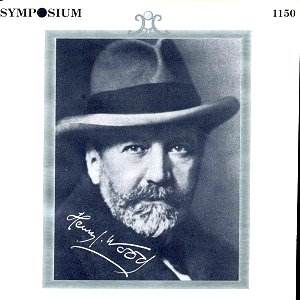
 BBC Symphony Orchestra/Henry
Wood
BBC Symphony Orchestra/Henry
Wood