Hearing Sir Roger’s
Beethoven symphonies as a cycle rather
than piecemeal has its rewards. One
can immediately admire the conviction,
the obvious belief in a viewpoint. At
their very best, the performances can
emerge as a breath of fresh air; at
the very worst, they are thought-provoking
(no bad thing). The rethinking of standard
repertoire at the behest of their Chief
Conductor has seemingly energised the
Stuttgart orchestra to great heights,
for they play with great elan and, at
times, real virtuosity. These are live
performances, and there can be an edge-of-the-seat
energy to them yet very little loss
of accuracy. Certainly there is no doubting
the enthusiasm of the audiences for
the end result, cheers appearing regularly
after final chords. The orchestra is
mainly modern instrument, with some
wind playing copies of period instruments
and valveless brass. Strings use less
vibrato than is the norm, resulting
in a convincingly ‘period’ feel.
The first symphony’s
introduction is swift and punchy, summing
up much of what is to follow in this
Nine. Norrington consistently highlights
the drama; textures are trumpet-dominated.
The second movement (I cannot write
‘slow movement’) is one-in-a-bar. The
final two movements are terrific, the
Menuetto’s marking of ‘Allegro molto
e vivace’ seeing Norrington in quicksilver
form. Always on its toes and together,
it leads well to the scampering scales
of the finale (with its real call-to-arms
at its outset). There is a quasi-operatic
slant to this finale (Beethoven’s Marriage
of Figaro???!!) No surprise that
the South West German branch of the
Sir Roger Norrington fan club are themselves
in good voice at the end.
For long it has been
incomprehensible to me why the Second
Symphony is so infrequently heard. Is
it seen as the weak link of the nine?.
Surely it is no such thing, and after
an arresting Adagio, the punchy and
vital allegro tells me that Sir Roger
agrees. Drama is high on the agenda
here, the suspensions close to the end
of the first movement being laid remarkably
bare. The slow movement flows, perhaps
too much (this time the marking is ‘larghetto’)
and it does on occasion sound
rushed. There is a distinct loss of
suavité, unfortunately, and certainly
of lack of interpretative depth. Much
better, then, the quickly shifting give-and-take
of the Scherzo, with its allusions to
the hunting horn. Norrington’s punchy
approach actually veers towards violence
in the finale, quite a shock if Beethovenian
Haydn is on one’s mind here. A rewarding
reminder of the stature of this piece.
A recent live traversal
of the Eroica by another period
specialist with modern forces (Brüggen
with the Philharmonia: S&H link)
proved instructive. Norrington brings
his own strengths to this noblest of
symphonies, without scaling Brüggen’s
heights. Lean, spare and clean lines
and a healthy forward tread ensure the
dynamism while a clear structural view
ensures comprehensibility. Of course,
the exposition repeat is observed. If
the slow movement is on the swift side,
it remains a dramatic statement. Some
passages could perhaps be more determined.
A surprise comes at 10’35, with the
second horn half-stopping his/her solo,
a remarkable aural effect. The hushed
close leads to a very on-the-ball Scherzo
and a Trio with nicely brash horns straight
from the chase. The finale promises
well, but sags before the end, running
out of steam. A shame, and a trait we
will revisit.
The Fourth is the first
disappointment. The Introduction lacks
mystery, the allegro vivace is almost
brutal, the Adagio fast and relentless
Brutality returns with the brass-dominated
‘explosions’ of the finale.
Revisiting the Fifth
and Sixth symphonies, I stand by my
earlier review of this disc (CD93.086).
The performances, Norrington at his
swiftest, exude a superficiality that
is initially exciting but ultimately
unrewarding.
The Seventh, after
an eloquent Sostenuto, provides a fairly
exciting Vivace. Quite why Norrington
pushes the pulse unnecessarily (read
‘rushes’) towards the end of the movement
is beyond me. It sounds contrived. For
someone who clearly favours the rapid
approach, it is strange that the finale
of the seventh fails to generate the
requisite voltage. The punchy, fresh
approach works much better in the outer
movements of the Eighth, where one can
positively feel Beethoven’s creative
juices flowing. The first is breezily
refreshing, the finale dynamism defined.
Alas, the Allegretto scherzando is hardly
‘scherzando’ at all, a predominantly
sour-faced scamper through the notes.
The Menuetto sounds more like a well-rehearsed
exposition of Norrington’s ideas on
period performance than Beethoven himself.
The Ninth, the greatest
of them all, fares well. The first movement
is dynamic, keeping good pace with the
swift changes of dynamic and emotion.
Certainly, this is a high-voltage account
and that is continued into the Molto
vivace second movement. Amazingly agile,
the bullet-like timpani is the star
here. Alas, the rapid speed of the ‘Adagio
molto e cantabile’ results once again
in a peripheral reading that, despite
many delights, fails to plumb the depths.
The finale, too, appears to skim across
the surface. The opening is crass and
there is little mystery when the lower
strings announce the ‘Ode to Joy’ theme.
Of the vocal soloists, Franz-Josef Selig
gets a bit lost in his melismas, and
Kaufmann is notable for his well-rounded
tenor. All four work well together as
a group, but just how large is the chorus?.
It sounds small, but amplified by recording
techniques.
The ‘extra’ disc is
of lectures (in German) given by Norrington.
Although they regurgitate some of the
information in the booklets, they are
not at present available in English
elsewhere.
Difficult to give an
overall rating for the set. The first
three symphonies are probably the most
convincing of the nine. As I said about
Nos. 5 and 6 (but it turns out to refer
to the entire exercise), Norrington,
if nothing else, is guaranteed to provoke
a reaction, good or bad.
Colin Clarke
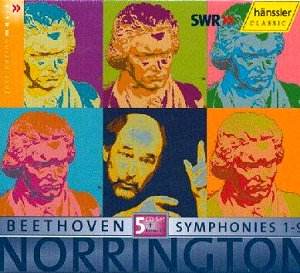
 Camilla Nylund (soprano); Iris Vermillion (mezzo);
Jonas Kaufmann (tenor); Franz-Josef Selig (bass);
Camilla Nylund (soprano); Iris Vermillion (mezzo);
Jonas Kaufmann (tenor); Franz-Josef Selig (bass);