Beecham wasn’t an habitual conductor of The Nutcracker.
He’d first performed it in abridged form during a tour with his eponymous
symphony orchestra – known for its occasional rowdiness, hence the soubriquet
‘the Fireworks Orchestra’ – back in 1911 though it continued to make
occasional appearances in his programmes. The Little Russian by
contrast was performed mainly as a run-through for the commercial recording
enshrined in this disc, which was made in 1953 – and he only returned
to the Symphony on two subsequent occasions. Nevertheless the pliancy
and debonair charm he lavishes on both works is almost enough to convince
us that these were works close to his heart. Beecham certainly was exercised
by the elegance of Russian music as Graham Melville-Mason’s notes reveal
and there’s no gainsaying the meticulous but generous delicacy of his
conducting, its nuance and subtlety as well as the moments of athletic
vivacity when required (more in the Symphony than in the Ballet Suite).
In The Nutcracker for example his principals
are on suitably delectable form. The flutes are delicious in the Allegro
giusto, whereas Beecham is quite slow – not cautious exactly but
rather patrician – in the March, though the pizzicati are animated
enough and rhythmic points register with unadorned excellence. There’s
verve and elegance in equal measure in the Trepak and the Danse
Arabe is taken at a decent speed, fully conveying its incipient
drama. Rather slower than usual but nicely inflected the Danse des
Mirlitons certainly escapes the charge of being over dainty and
merely elfin in Beecham’s leisurely hands. Come the Valse des Fleurs
and we can admire the burnish of the RPO’s violas and cellos and
the effulgence of the brass. Don’t expect daemonic drive from this Nutcracker;
Beecham is altogether more affable and even-tempered.
More distinction attends the performance of the Second
Symphony. Beecham instils a strong melodic curve and contour to the
lyric line of the opening Andante sostenuto. His rhythmic clarity
is well conveyed and he deploys brass with strategic strength. Jack
Brymer’s clarinet is much to the fore in the Andantino marziale –
a movement retrieved from the 1869 opera Undine – in which Beecham’s
tempo is just right, one that conveys depth through movement. The Scherzo
by contrast is vivacious and full of colour, rhythmic dash and a controlled,
never headlong, momentum. Beecham extracts optimum wit from the trio
section as well. The way in which he drives the finale is laudable but
equally so the manner in which principals are given sufficient time
to phrase. The lightening of string textures is but one component of
his success here – a product of careful delineation, imagination and
an acute ear. As Beecham once or twice ruefully remarked, whatever else
anyone said of him, good or bad, no one ever complimented him on his
sheer hard work.
The tapes have come up splendidly and whilst this might
be thought one of the less immediately appealing issues in the latest
batch of Beecham/Sony discs – for the less enticing repertoire not for
any performance liabilities – it’s nevertheless chock-full of charm
and verve, of elegance and charm.
Jonathan Woolf
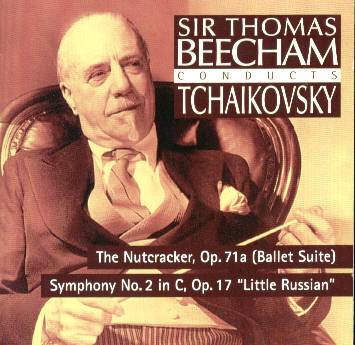
 Royal Philharmonic Orchestra/Thomas
Beecham
Royal Philharmonic Orchestra/Thomas
Beecham