I first encountered the music of Paul Patterson
when, as a brass band trombonist in my early teens with a voracious
(some thought unhealthy!) appetite for new music, I came across
the "experimental" works for brass band, Cataclysm
and Chromascope. Not long after came Deception Pass,
a ten-piece brass work written for the Philip Jones Brass Ensemble.
At the time, the band pieces in particular fascinated me with
their indulgence in colour, imaginative effect and sheer sound
for its own sake. Techniques such as "half-valving"
abounded and coupled with Patterson’s
use of certain aleatoric methods it seemed he was taking the brass
band repertoire into unchartered territory. Of course, at the
time I had only very limited knowledge of the music of Lutosławski
and Penderecki and it was in their work that Paul Patterson’s
language was firmly rooted. Looking back on these pieces over
twenty years on, the impression is that this was music very much
of its time. I suspect that they would now sound somewhat dated
in concert performance. As we well know the passage of time is
not always kind, even in music.
At around the time that I was busy discovering
this "new" music however, Patterson was already moving
on, no doubt believing that he had exhausted this particular avant-gardist
avenue. As a result he was to turn to more familiar harmonic territory
and broadly traditional notation, a change that he first embraced
on a large scale from around 1980 onwards. The signs of what was
to come had already been in evidence prior to this within a number
of smaller works. Remnants of his earlier style do still surface
in later works, as can be clearly heard in Flood from Mass
of the Sea.
The Concerto for Orchestra, premiered
in 1981 and available in the EMI British Composers series was
one of the first larger scale works to figure following this stylistic
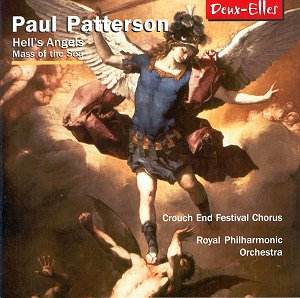
change and by the time Patterson came to write the Mass of
the Sea in 1983 the change of language had asserted itself
still further. What did not change was the sheer facility of Patterson’s
scoring, always inventive, imaginative and often teeming with
rhythmic energy and momentum. The Mass of the Sea is cast
in six sections broadly following the traditional Latin Mass service
but substituting for the Credo a devastating depiction
of the flood and utilising biblical texts as well as original
material by librettist Tim Rose-Price. The musical response can
be startlingly diverse in its conception, ranging from the austere
opening Kyrie, painting a bleak picture of the void before
creation, to the Copland and Chavez-tinged celebrations of the
Gloria, to the unexpectedly restrained but touchingly beautiful
setting of the Sanctus and Benedictus. This 1987 recording,
previously available on RPO records, captures the atmosphere of
the work admirably, not least in the awesome unleashing of natural
power in Flood.
In Hell’s Angels, written in 1998, Patterson
revisits his earlier language once again, turning not to the orchestra
for choral accompaniment but to a striking ensemble of percussion
and amplified string quartet from which he draws a fascinating
range of effects and colours/ The polystyrene cups used on the
strings at the outset of the movement entitled Destruction
will either be loved or hated! The inspiration is again wide-ranging,
combining passages of chaos, both organised and
otherwise, with shouting crowds and vocal effects that at times
bring to mind Berio as much as Penderecki or Lutosławski.
The American influence is present again in Gonna Take
a Run, a play on Steve Reich this time, both in title and
music. As in Mass of the Sea the texts are drawn from both
biblical sources, in this case the Old Testament, and the contemporary
(Ben Dunwell). Excerpts from Milton’s ‘Paradise Lost’ are another
link, if inadvertent, to Penderecki. From all of this emerges
the final Vision, a profound and serious conclusion to
the work, which ends questioningly as a solo soprano intones words
from Psalm 139.
In his booklet notes Paul Pellay asserts, "Patterson
has been pre-eminent as one of this country’s most distinctive
and respected composers". Well, his use of ‘pre-eminent’
may just be stretching the point a little but there is little
doubt that Patterson composes with a natural technical facility
and flair that can produce compelling results. Stylistically,
there are some doubts as to whether he has ever been truly successful
in finding a wholly individual voice but that should not detract
from the appeal of these works. Mass of the Sea in particular
offers much to enjoy.
Christopher Thomas
 Royal Philharmonic
Orchestra/Geoffrey Simon
Royal Philharmonic
Orchestra/Geoffrey Simon