You can rely on
Martinů to surprise ... even to disconcert. The First
Sonata tangily marries Bachian gestures with the sort of jazziness
we find in Constant Lambert's Music for Orchestra and Piano
Concerto. After a stark march and a Pierrot pizzicato andante
comes a brief stabbing-slashing allegretto. The Second Sonata
carries some of the neo-classical stigmata of 1920s Paris
but then in comes a new liberated singing element which I associate
with the composer’s Czech homeland. This comes in the first movement
with some Stravinskian coating which peels away completely in
the lovely larghetto (tr. 5) reminding us of the delights
of the ballet Špaliček and
The Miracle of Our Lady. Petrushkan rhythmic edginess returns
for the chirpy Poco allegretto. The Second Sonata is an
altogether delightful work, succinct and a boldly balanced marriage
between, form, material and duration. The 1933 Sonata for two
violins takes, in its outer movement, the neo-classical impetus
of works such as Holst’s Double Concerto and marries it with a
pawky humour. Some nationalist flavouring is present though not
quite as pronounced as in the Second Sonata.
Twelve years and a world war later finds the
Third Sonata written in Martinů's
instantly recognisable language of high maturity. Jazziness has
vanished and so has neo-classical desiccation. Instead we get
his convulsive incessant rhythmic interplay fused with a bubbling
and singing nationalistic energy. This Sonata is of a piece
stylistically with the six symphonies especially the Fourth and Fifth
which it sometimes echoes. After a plangently hypnotic adagio
comes a nervy and driven scherzo. While the sonatas for
the Parisian thirties were each in three movements this is in
four. The finale combines energetic brilliance with the reflective
tendency of a nostalgic exile. As Laurie Shulman says in the liner
notes this work is the musical heart of the project. At thirty
minutes it is of the same duration as the symphonies and is every
bit their equal though for just two instruments.
I have not been able to compare this disc with
the Supraphon, Studio Matous, Bonton and Panton recordings but
this strikes me as a very useful coupling bright with the conviction
of all the artists involved.
Rob Barnett
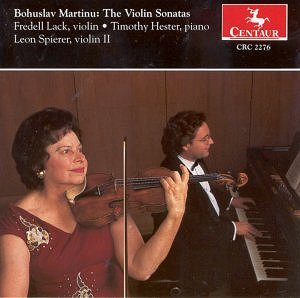
 Fredell Lack (violin)