COMPARISON
(same program): Perahia/Abbado – Sony Classics 64577 [57:20]
Kurt Masur is one of our most well known conductors
of the central symphonic repertoire but Peter Rösel is a
hidden treasure who spent most of his productive years behind
‘The Berlin Wall’. In recent years, Berlin Classics has issued
many of his recordings. Although they have uniformly received
excellent reviews, Rösel remains a pianist who is rarely
mentioned in the same sentence as a Perahia or Goode. If memory
serves me correctly, my first exposure to Rösel was an EMI
disc of the Weber Piano Concertos (now on Brilliant Classics)
played in excellent fashion. Every other Rösel disc since
that time has received many hours of play on my home audio systems.
More often than not, recordings of Schumann’s
famous A minor Piano Concerto are coupled with a major Schumann
solo work or another famous concerto such as the Grieg Piano Concerto,
also in the key of A minor. Rösel and Masur deviate from
the norm in programming the two piano-with-orchestra works from
Schumann’s later years. As it happens, I have a disc from Murray
Perahia and Claudio Abbado with the same program, and I used this
recording extensively in the review process.
Schumann’s Concerto has a piecemeal history.
In 1841, he wrote a one-movement Fantasy that no publisher would
touch. The advice he received was to add two movements to make
the work into a concerto. Schumann evidently didn’t take immediately
to the advice, because it took him four years finally to add the
two movements. Further, it is ironic that the last thing he did
with his Concerto was to add a transition between the 2nd
and 3rd Movements, this transition being one of the
most famous in all classical works.
The piecemeal history would tend to indicate
that Schumann’s Concerto would not have a strong level of coherence.
However, Schumann overcame that possibility by using, in different
guises, the A minor primary theme of the 1st Movement
throughout the work. Thus, the A minor Concerto is essentially
monothematic and has raised some complaints from listeners that
Schumann’s wealth of creativity in the Concerto is rather low
and that the composition is too long. A different line of thought
is that Schumann masterfully varied the A minor theme to the extent
that most listeners would not be aware of its monothematic elements.
Personally, I consider the 1st Movement too extended,
but the other two movements possess perfect length.
Comparing the Perahia and Rösel recordings
of the Piano Concerto brings into view a basic difference in presenting
stereo sound. Perahia’s soundstage is the typically modern one
of very small spacing between instruments that leads to a homogenized
sound where distinctions among voices decrease. I won’t deny that
it sounds attractive, but at the loss of detail. Particularly
in the 3rd Movement, Perahia’s projection has trouble
gaining distinction above the orchestra.
With Rösel’s recording, the stage is much
wider. When the time strikes for Rosel to ascend, his soundstage
is fully agreeable. Rösel takes full advantage, giving a
performance that rivals the outstanding performance of Jorge Bolet
on Decca conducted by Riccardo Chailly. His exuberance is boundless,
and he weaves his way through the orchestral tapestry of the 3rd
Movement with distinction and a great rhythmic pulse. He also
does very well with the poignancy of the 1st Movement,
although Perahia’s inflections are more incisive. Both conductors
are excellent in keeping the music interesting and uplifting,
although Abbado takes a more cultured path while Masur conveys
a rustic atmosphere. Overall, I find the Rösel version compelling;
Perahia is enjoyable.
Although Schumann’s later two works for piano
and orchestra do not scale the heights of the A minor, they are
worthy of a fine interpretation. Perahia’s versions are smooth
and rather serene, because Abbado fails to create significant
tension. Yes, his orchestra can be quite loud and make grand gestures,
but the lack of tension means lack of urgency. Masur gives us
hard-hitting performances recognizing that Schumann wasn’t a has-been
in his later works and that his inner world retained elements
of desperation. Abbado conveys a man who has lost ‘the edge’;
by doing so, Florestan also becomes more benign.
The 3-minute time differential between the two
discs is of little significance. To be honest, I only noticed
a difference in tempo with the Intermezzo to the Piano Concerto,
and Rösel was the quicker and more refreshing pianist.
In summary, I heartily recommend the Rösel
disc for its idiomatic performances. The 3rd Movement
of the Piano Concerto is one of the best on record, and the two
later works are also very impressive. The sound quality is lacking
richness, but I am well satisfied with the expansive and crisp
soundstage. As for the Perahia recording, the sound integration
and Abbado’s somewhat limp portrayal of Florestan in the later
works are problematic features that give the disc a low priority.
However, those who place highest attention on the beauty and grace
of Schumann’s music will certainly have a more favorable opinion
of the performances than I possess.
Don Satz
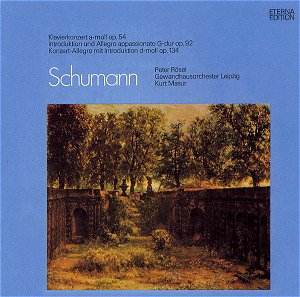
 Peter Rösel (piano)