The Requiem Mass of Gabriel Fauré differs
from the similar works of his contemporaries. It is a gentle and
serene work, eschewing the fascination with death, judgment and
destruction that so captivated Verdi, Cherubini and Berlioz. Fauré’s
view of death was much more optimistic. Death was not to be feared;
rather it was to be welcomed as a relief from suffering and the
passage into a more blissful life. With that philosophy in mind,
Fauré opted to set only two verses of the Dies irae.
The end product is one of the most lofty and sublimely melodic
works in the standard choral repertoire.
Alas, this aging performance by André
Cluytens and company does little to inspire. Rather, we are faced
with forty minutes of nearly unbearable singing, rescued only
by the superb performances of the soloists, who, then at the start
of their careers, lend credibility to an otherwise excruciating
performance.
Much of the fault lies with Cluytens’ lugubrious
tempo choices. In every sense this reading is entirely too slow.
Fauré’s lofty and ethereal melodies are crucified when
they are stretched beyond recognition. In the one truly dramatic
moment of the entire work, the Dies illa portion of the
Libera me, there is absolutely no sense of forward motion,
urgency or conflict. Sure, Fischer-Dieskau’s near-perfect solo
work is worth a listen, but even such fine singing as his cannot
rescue this turgid rendition.
Now on to the most important element in any performance
of this piece: the choir. Until conductors like William Christie
and Philippe Herreweghe went to France and taught them how to
sing, French choirs were notoriously terrible. This is a prime
example of the low state of choral affairs that was predominant
in France in the ’fifties and ’sixties. There is absolutely no
blend and the vibrato is completely out of control. Especially
horrendous are the tenors and sopranos who sound as though their
average age was seventy. The sopranos wobble and blare and the
tenors bleat like goats. There is not a redeeming quality to be
found in the choral singing, and given the superb alternative
choices in recordings of this work, it baffles me altogether that
this one has even survived, let alone qualified to be called a
"great recording of the century."
On the positive side, we do get to hear two legendary
soloists in their prime sing some beautiful music. Alas, this
too is hampered by the recorded sound, which places both soprano
and baritone smack in front of a microphone, giving the sense
that the orchestra is in the next room.
Orchestral playing is warm and lush, and the
strings provide a lovely sheen to the proceedings. Alas, the wind
playing is as out of tune as the chorus sopranos and the choice
of organ registrations is obnoxious and out of place, especially
in the divine In paradisum.
EMI are to be commended for including an informative,
but brief program note, and a complete text and translation. They
are to be condemned however for issuing a disc with a meagre forty
minutes of music. Surely there is something in the EMI vaults
that would have made an appropriate filler.
Unless you are a collector of Fischer-Dieskau
or de los Angeles, there is nothing else that should convince
you to add this disc to your collection.
Kevin Sutton
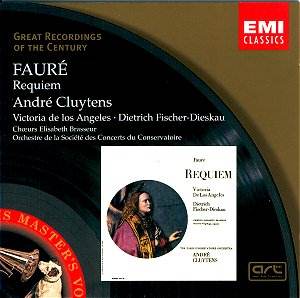
 Orchestre de la Société
Concerts du Conservatoire/André Cluytens
Orchestre de la Société
Concerts du Conservatoire/André Cluytens