Naxos here continue their series of reissues
of performances of the Beethoven symphonies conducted by Felix
Weingartner (1862-1942). This conductor was, in fact, the first
to record all nine symphonies and, having been impressed with
his accounts of the first two, I was interested to see what he
would make of these two products of Beethoven’s maturity. As Ian
Julier tells us in his notes, these recordings were, in each case,
the third recordings of the symphonies that Weingartner made.
He had set down earlier versions of both in 1923 and 1927, on
both occasions using British orchestras.
He leads a good account of the Seventh Symphony.
In the first movement it’s evident that the conductor has a tight
grip on the rhythm. Sometimes I’ve heard performances in which
the impelling dotted rhythm sags and becomes sluggish. That certainly
doesn’t happen here. The rhythm has "kick" and bite
though, as Ian Julier observes, rhythm "never becomes an
obsession in itself." I have to say, however, that in the
last analysis the performance does not have the same degree of
verve and élan that distinguishes Carlos Kleiber’s 1976
account with the VPO of a later generation. I’ve paid Weingartner
the compliment of comparing his account against what I believe
to be the finest, most incandescent version ever set down.
There’s an impressive gravitas and restraint
to Weingartner’s reading of the slow movement. Interestingly,
however, he doesn’t retain the same pulse throughout. He begins
almost at a slow trudge but quickens the pace for the passage
where the flute and bassoon counter-melody is heard (track 5 from
4’38"), accelerating further a little while later before
resuming the original tempo around 6’28". The scherzo, in
which repeats are not made, dances along effectively, though at
nothing like Kleiber’s supercharged pace. However, I find that
the much slower speed for the trio (track 6, 1’31") doesn’t
work too well. At this pace the music gets bogged down. It’s interesting
that Weingartner and Kleiber’s timings for this third movement
are pretty similar but the younger conductor observes all repeats
and is nothing like as slow in the trio.
I agree with Ian Julier’s observation that in
the finale Weingartner’s decision not to rely on mere speed for
effect is the right course. His is a poised account which builds
tension progressively and impressively. It’s just a shame that
the age of the recording means that the horns aren’t heard to
ring out as they should. However, I don’t find that Weingartner
conveys the same Dionysian sense of exaltation that Kleiber does
in this movement (who does?) although Kleiber’s speed is not noticeably
faster than Weingartner’s. The other comparison I made was with
Toscanini’s 1935 BBC Symphony Orchestra performance (on BBC Legends).
I found that the Italian maestro consistently conveyed a greater
sense of excitement and occasion … and in the finale his horns
"tell" more. That said, this Weingartner reading is
still a very good, sane and tightly controlled account of this
symphony and the VPO play well for him.
The recording of the Eighth Symphony is
also a success. The first movement is bracing and alert; as usual,
there’s no exposition repeat. The witty little pay off at the
end is nicely turned. The perky second movement is given a pert
reading with nice, crisp articulation from the VPO. In the third
movement the second repeat is omitted, though other repeats are
observed. The finale is not rushed off its feet but makes a good
impact for precisely this reason. All in all this is a good, clear,
unfussy performance of Beethoven’s most engaging symphony and
I enjoyed it very much.
To complete the concert Naxos include three movements
from the incidental music to Egmont. The account
of the overture is thrustful. It’s more "conventionally"
paced than the 1957 traversal by Klemperer, which I reviewed recently,
and listeners may prefer that. In addition to the familiar overture
Naxos include two less well-known items from the incidental music
though I wish they had left a slightly longer gap between the
Overture (track 1) and the following item. The overture was set
down on the same day as Weingartner’s recording with the VPO of
the First Symphony which Naxos have issued separately. I thought
the orchestra were on more incisive form in the overture. The
other two pieces were recorded on a different occasion, in London.
‘Clärchen’s Tod’ (track 3) is a particularly affecting, tragic
lament. Weingartner does it very well though I must say that in
his 1957 reading with the Philharmonia, Klemperer, at a slower
tempo, digs even deeper and achieves the not inconsiderable feat
of getting even more out of a piece of music a mere three minutes
long.
These Beethoven performances are all unfussy,
objective readings which respect the score. They come in good,
clear transfers and are accompanied by well-written, informative
notes. Even today, over sixty years after they were made, these
recordings can teach us much about these familiar masterpieces.
I am very glad to have heard them and will certainly return to
them. They are well worth investigation, especially at the attractive
Naxos price.
John Quinn
see also review
by Chris Howell
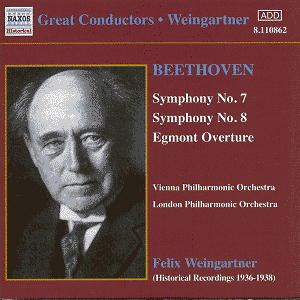
 a Vienna Philharmonic
Orchestra/Felix Weingartner
a Vienna Philharmonic
Orchestra/Felix Weingartner