Other Links
Editorial Board
-
Editor - Bill Kenny
Assistant Webmaster - Stan Metzger - Founder - Len Mullenger
Google Site Search
SEEN AND HEARD INTERNATIONAL OPERA REVIEW
Wagner, Tristan und Isolde: Orchestra and Chorus of Hungarian State Opera - Ádám Fischer, conductor, Palace of Arts, Budapest, 16.6.2010 (BM)
The fifth installment of the annual Budapest Wagner-Napok, or Wagner Days, kicked off with a dream come true for Ádám Fischer: Tristan und Isolde in his home town with an essentially Hungarian artistic team and cast. A distinguished Wagnerian conductor with many celebrated performances in Vienna and Bayreuth under his belt, Fischer likes to tell the story of how one of his very worst childhood experiences was being forced to listen to an entire live broadcast of Tristan from the Met by his music-loving parents. Needless to say, the score has grown on him since, and he is now dedicated to making this and Wagner’s many other masterpieces more accessible to younger generations.
Hence the auspicious choice of two imaginative young Hungarian directors, Magdolna Parditka and Alexandra Szemerédy, who together tried their hand at a fresh approach to a work that is still as progressive as ever in the way it focuses on the love rather than the adultery involved in the plot, making a case for a love not defined by social obligations and marital conventions. These themes were given a new look, emphasizing precisely this avant-garde vision.
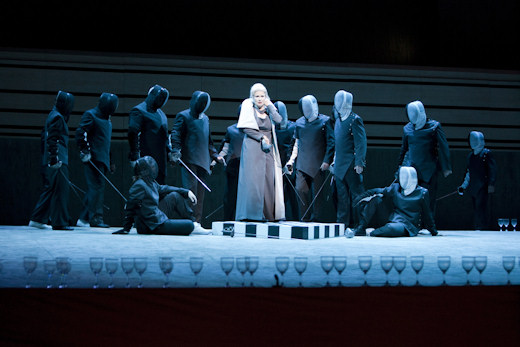
Voices murmuring the verses written by Gottfried von Strassburg long ago are the first sound to meet our ears as the lights go down, only to fade seamlessly – as if the composer himself had called for it - into the opening strains from the orchestra, gradually building up and culminating in a spell-binding Tristan-chord. Apart from the notion of making Tristan and King Marke into fencing champions, most of the directors’ ideas are meant to bring out the inner drama of the two title characters. The symbolism is stark, simple yet gripping: contrasts of water, fire and earth, the black and white of a chess game that both can only win or lose together, offset by the red color of blood and love, light and shadows reflecting the duality of night and day, a stage lined with empty glasses during the first act, which are subsequently filled and overturned as the story unfolds. There is more, a crack in the backdrop, widens slowly but surely into huge gash, creating the illusion that the stage is about to break in two – all of this was designed to great effect, as were the costumes.
And yet, despite all of these fine ideas, there were boos for the directors on opening night, perhaps because the one thing lacking in all of this was some convincing interaction between the characters, which resulted in a stylized outlook with more than a few dull moments as a consequence. Above all, there seemed to be no chemistry whatsoever between the two lovers, who spent most of the time singing into the distance from either side of the stage. Christian Franz as Tristan is an unreliable performer at best, and on this evening he reminded the audience that he has seen better days, his unkempt look all the while making Isolde’s infatuation with him seem hardly plausible. Anna-Katharina Behnke, for her part, was able to do the other principal role justice, and although flagging ever so slightly at times, she pulled through admirably and delivered a superb and poignant Liebestod. Not only that, she has the great advantage of looking absolutely fabulous on stage (no credibility problems with respect to Tristan’s passion there). Jan-Hendrik Rootering was a very civilized King Marke, but all in all, the Hungarian singers in the other ‘supporting’ roles outshone their colleagues from abroad as if there were nothing to it. Tomasz Konieczny as Kurwenal was as arresting and passionate as his diction was word-perfect, and it is no exaggeration to say that Judith Németh’s Brangäne was the star of the show – her beautiful, powerful mezzo allowed her to remain in perfect control at all times, and she is a handsome woman with striking stage presence.
Next time, Fischer might be well-advised to take the plunge and go straight for an entirely domestic cast – young and unknown, potentially exciting singers in title roles can sometimes be just as good a way to draw audiences as older, more familiar ones. But be that as it may, his mastery in the orchestra pit with the outstanding ensemble of Hungarian State Opera, not to mention the beauty of the magnificent city of Budapest, along with the inspired productions he has been responsible for so far, will undoubtedly keep opera-goers coming back to the Budapest Wagner Festival (which once again included a full performance of the entire Ring Cycle this year).
“The chromatic music of Tristan may have been just one small half-tone step for Wagner, but it was a giant leap in the history of music,” says Fischer, and one can hardly blame him for being so pleased with this allusion to the first landing on the moon, considering the significance of Novalis’ nocturnal, lunar verses for this particular opera. By the same token, the Wagner-Napok may be a comparatively small step in Fischer’s career, but is still a very significant contribution toward making Wagner’s music more accessible and popular with younger audiences.
Bettina Mara
Picture © Palace of Arts - Budapest / János Posztós
Read more about Budapest’s new Palace of Arts Here.