|
|
|

Editorial
Board
London Editor:
(London UK)
Melanie
Eskenazi
Regional Editor:
(UK regions and Worldwide)
Bill
Kenny
Webmaster:
Bill
Kenny
Music Web Webmaster:
Len
Mullenger


|
MusicWeb is a
subscription-free site
Clicking Google adverts on our pages helps us keep it that way
Seen and Heard Article
New
Broom at Glimmerglass Opera Festival:
Michael MacLeod sweeps all before him (SL)
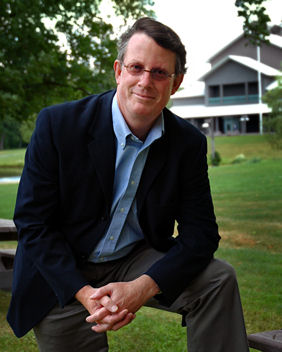
Michael MacLeod
If Michael MacLeod said it once, he said it
several times when I met him between operas at
Glimmerglass this month: “I owe so much to John
Eliot Gardiner – I worked with him for more than
ten years and I can’t over emphasise what a
marvellous opportunity it was for me and I can
only express my admiration and gratitude.”
Organising the Monteverdi Choir & Orchestra’s
famous World Tour, then spearheading Gardiner’s
project to conduct and record all seven of
Mozart’s mature operas, and following that with
five years as Director of the City of London’s
Festival, must have been an ideal training ground
for this quietly-spoken Scot’s latest venture on
the scenic shores of Lake Otsego where he has
taken over the helm as General & Artistic Director
from the much-admired Paul Kellogg. If the
wooded hills surrounding Glimmerglass Opera remind
him of his native land, he isn’t saying, but after
earlier times with both Scottish Opera and the
Scottish Baroque Ensemble, it must seem a little
like coming home – even if the nearest town of
Cooperstown 8 miles further south on the
lake-shore is, in contrast, a hotbed of that very
American obsession, baseball. To speak to almost
any of the town’s August tourists is to very
quickly realise that it is that sport’s Hall of
Fame Museum, and very early example of a
ball-park, which draws them. “Opera? Is there
opera here? I guess I didn’t know that” is a
typical comment.
No matter – since its inaugural season in 1975
when La Bohème was played to 1,200 local
residents who did want more than baseball,
Glimmerglass Opera has continued to thrive, to
grow and to gain a now-international reputation,
and to become what Opera Now recently described as
“the most consistently interesting and
forward-looking opera in the U.S. today.” Much
of that reputation must be down to the vision and
hard work of Kellogg, and although MacLeod is the
first to recognise the debt of recent history, he
has his own vision and his own plans for this very
American enterprise where, this year, we see the
outlines of his grand design with a complete
season devoted to the myth and music of the
Orpheus legend. From Monteverdi’s seminal work of
1607, through the new Bärenreiter edition of
Berlioz’s arrangement of the Gluck French version,
via Offenbach’s fizzy delight in a new English
translation by Glimmerglass’s own Kelley Rourke to
the 1993 Orphée of Philip Glass, MacLeod
has obviously laid down his blue-print for the
future. If Glimmerglass is an opera festival,
then this year it is a real Festival with not only
a theme, but an entire operatic and artistic
experience surrounding and supporting it. As well
as the four staged operas there are two concert
performances, somewhat abridged, of the less well
known Haydn take on the story: his L’Anima del
Filosofo, plus showings of the films “Orphée”
and “Black Orpheus” – not to mention talks,
seminars, recitals, and art exhibition by one of
the singers, and “meet the artists” events. To
spend even a few days on the lake shore is to
experience total Orpheus-immersion.
If Glimmerglass is now renowned for it’s
commitment to young singers through its Young
American Artists Program, it is equally admired
for the wealth of new productions that are hosted,
year after year. Both aspects attract some of the
world’s best artists who come not only for the
relaxing surroundings, but also for the guaranteed
generous rehearsal time – a boon to directors and
singers alike these days. This 2007 season is no
exception and, as the first season entirely under
his control, MacLeod has ensured that all the
Orpheus-inspired works are either entirely new
productions, or new to that stage. And with the
likes of directors Christopher Alden, Lillian
Groag, Eric Einhorn and Sam Helfrich in control on
the stage, collaborating with some of America’s
most talented and exciting young singers such as
Michael Maniaci, Michael Slattery, Jill Gardner
(all ex Young American Artists), and Lisa Saffer,
then it is clear that we have a recipe for both
stimulating, and sometimes provocative, opera.
There is, however, one aspect of Glimmerglass’s
future that is still shrouded in mystery: that of
who will be its new Musical Director. The post is
open, and it was clear this summer that it is both
much-needed and that the competition is hot.
There were signs in some of the operas of some
confusion as to musical focus and style, but there
was also the chance to see some talented and
aspiring young conductors at work, sometimes even
within the same piece. It was particularly
puzzling when a concert performance of Haydn’s
L’Anima del Filosofo with its three singers
was split between two batons: those of Antony
Walker and Anne Manson. MacLeod explained: “we
needed to give an equal chance to the contenders
for the post and each is expected to conduct both
a work with chorus, singers and orchestra, and
then also a work with no chorus. The only way
with the Haydn, where there is no chorus, was to
split the conducting.” The other two conductors
at work on site are Julian Wachner (Gluck/Berlioz)
and Jean-Marie Zeitouni (Offenbach). If a racing
bet were permitted, I would put short odds against
either Manson or Walker.
Whoever is chosen will have a chance to build a
new artistic fiefdom within the MacLeod empire and
we can expect some interesting times ahead for
Glimmerglass. One glimpse into that future might
have occurred this summer already as MacLeod made
clear his sponsorship of some challenging
productions and castings. Building on the
company’s 2005 collaboration with the Leeds-based
Opera North in the UK, he brought over from there
Christopher Alden’s spiky and thought-provoking
take on Monteverdi’s L’Orfeo. This
reading, which has the poet/singer transposed into
some kind of grunge-king pop idol, surrounded by
asexual acolytes inhabiting perhaps a drug-baron’s
palatial pad, certainly left the
surprisingly-conservative Glimmerglass audience
somewhat unsure – to say the least. Another
challenge was laid down with the courageous and,
as it turned out, inspired casting of young male
soprano Michael Maniaci in the title role of
Berlioz’s lushly augmented adaptation of Gluck’s
Orphée et Eurydice. Maniaci was a dramatic
and vocal delight, relishing the emotional and
technical demands with an élan that cheered the
soul and totally vindicated his selection. The
audience noisily agreed.
When matched with the perhaps surprising success
of the Glass, and the more obvious attractions of
the Offenbach, it is no surprise that this
inaugural MacLeod season has already been deemed a
triumph. What next from the Brit in the land of
baseball? Well, how about a Shakespeare season?
Next year all four productions new to the
Glimmerglass Festival are to inhabit just one
iconic set - that of an Elizabethan theatre.
“The four operas – Wagner’s early comedy, Das
Liebesverbot, Handel’s Giulio Cesare,
Cole Porter’s Kiss Me, Kate and Bellini’s
I Capuleti e I Montecchi – will demonstrate
far more diversity on one set than would have been
seen in four plays at the Globe in Shakespeare’s
day, and it will be the music, costumes and
lighting that will emphasise the variety among the
four works”, MacLeod says. He’s already
contracted and drawn up some short lists of young
singers who revel in the more dramatic aspects of
their work. If 2007 was an earnest of the new
Director’s intentions, then 2008 is going to be
the real thing. Be there if you can.
Sue Loder © 2007
Picture © George Mott / Glimmerglass Festival
Opera
Back
to the Top
Back to the Index Page
|
Seen and Heard, one of the longest established live
music review web sites on the Internet, publishes original reviews
of recitals, concerts and opera performances from the UK and internationally.
We update often, and sometimes daily, to bring you fast reviews,
each of which offers a breadth of knowledge and attention to performance
detail that is sometimes difficult for readers to find elsewhere.
Seen and Heard
publishes interviews with musicians, musicologists and directors
which feature both established artists and lesser known performers.
We also feature articles on the classical music industry and we
use other arts media to connect between music and culture in its
widest terms.
Seen and Heard
aims to present the best in new criticism from writers with a radical
viewpoint and welcomes contributions from all nations. If you would
like to find out more email Regional
Editor Bill Kenny. |
|
| |
|
Contributors: Marc
Bridle, Martin Anderson, Patrick Burnson, Frank Cadenhead, Colin
Clarke, Paul Conway, Geoff Diggines, Sarah Dunlop, Evan Dickerson
Melanie Eskenazi (London Editor) Robert J Farr, Abigail Frymann,
Göran Forsling, Simon Hewitt-Jones, Bruce Hodges,Tim Hodgkinson,
Martin Hoyle, Bernard Jacobson, Tristan Jakob-Hoff, Ben Killeen,
Bill Kenny (Regional Editor), Ian Lace, John Leeman, Sue Loder,Jean
Martin, Neil McGowan, Bettina Mara, Robin Mitchell-Boyask, Simon
Morgan, Aline Nassif, Anne Ozorio, Ian Pace, John Phillips,
Jim Pritchard, John Quinn, Peter Quantrill, Alex Russell, Paul
Serotsky, Harvey Steiman, Christopher Thomas, Raymond Walker, John Warnaby,
Hans-Theodor Wolhfahrt, Peter Grahame Woolf (Founder & Emeritus
Editor)
|
Site design: Bill Kenny
2004 |