|
|
|

Editorial
Board
London Editor:
(London UK)
Melanie
Eskenazi
Regional Editor:
(UK regions and Worldwide)
Bill
Kenny
Webmaster:
Bill
Kenny
Music Web Webmaster:
Len
Mullenger



|
MusicWeb is a
subscription-free site
Clicking Google adverts on our pages helps us keep it that way
Seen
and Heard International Opera Review
Gounod, Faust:
Soloists, Chorus and Orchestra of
Staatstheater Darmstadt,
Conductor
- Martin Lukas Meister 5.7.2007
and
Verdi: Il Trovatore:
Conductor - Alexander
Stessin 7.7.2007 (BM)
Ever since
Stockhausen’s day, Darmstadt has been
home to avant-garde cultural tastes.
You wouldn’t necessarily think so when
moving about among the unassuming,
small-town audience chatting to each
other in their quaint Hessian accents
during intermission, but they are
privy to an opera stage offering
sophisticated productions - and very
affordable tickets.
The theater’s slogan for this summer
was “Darmstadt liegt am Meer”
(Darmstadt is a seaside town), with
sand boxes and lounge chairs set up in
front of the recently renovated
building to “prove” it, bringing back
a popular motto from the 1970’s: “In
Darmstadt leben die Künste”
(The arts are alive in Darmstadt). Two
of this season’s productions from
inspired director Philipp Kochheim,
with sets and costumes by Thomas
Gruber and Bernhard Hülfenhaus,
have established that this is still
very true.
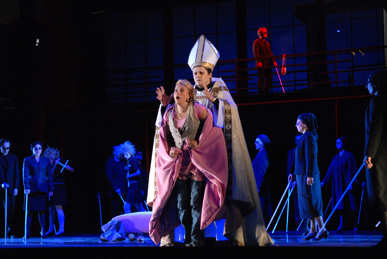
Gounod’s Faust was a
appropriate choice for Darmstadt, the
city where this work received its
German premiere in 1861, attended by
the composer himself – and it’s safe
to say he would have been pleased with
Martin Lukas Meister’s sensitive
reading of his score today. Mark Adler
sang the title role admirably,
expressing the many nuances of the
fraught scholar who longs for one last
chance at youth and love, no matter
what. Nonetheless, he was outshone by
a brilliant Anja Vincken as
Marguerite, not to mention the
astounding panache of Dimitry
Ivashenko as M éphistophélès.
The chorus sang beautifully in the
scene following Valentin’s death, this
character in turn portrayed
wholeheartedly by Oleksandr Prytolyuk.
But here is also the point where some
of the hitches in this reading became
apparent. Would a brother still kill
the man who has “dishonored” his
sister in this day and age? Not a very
plausible story, at least not in this
part of Europe (- best move it
elsewhere?). And would a teenager just
back from shopping at Zara be
listening to a traditional German folk
song on her walkman? Hardly – the
thought seems just as ridiculous as
her pink bedroom, the kind of thing
you would expect from Doris Dörrie,
the German film director who has been
dabbling in opera of late, with
debatable taste.
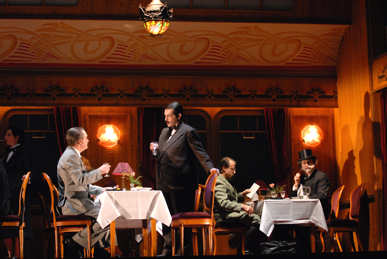
But with any luck, I will be forgiven
this snide remark, since there is
little I can do but rave about
Darmstadt’s Il Trovatore. What
a stroke of genius to set this piece
in the 1920’s on the Orient Express,
the set an intricately detailed
cross-section of the train’s
carriages. Ferrando, the narrator,
becomes Hercule Poirot, and the plot,
so often criticized for being
excessively bizarre and far-fetched,
is perfect for a murder mystery, while
losing nothing of its craziness and
passion. The aristocrats travel in
luxury carriages, while the gypsies
crowd into the third class. Luna,
joined by Poirot, listens to the
soldier’s chorus on an old 1912 vinyl
recording, and even Verdi himself is
frequently seen on stage, observing
the action and scribbling away, as if
he were still busy improving his
score. The German surtitles were meant
to resemble film dialogues – an
interesting idea, but also slightly
unnerving, since you didn’t need to be
well versed in Italian to notice that
at least half of it was being left
out. Four top-knotch soloists are
required to make any performance of
this opera a success, and they were
indeed first-rate: Zurab Zurabishvili
lent his belcanto tenor to the part of
Manrico and Sang Lee (from N ürnberg
Opera) was a razor-sharp Count Luna,
alongside Elisabeth Hornung’s searing
Azucena and Allison Oakes’ outstanding
Leonora, at her very best during the
fiery cabaletta in the final section
(a passage occasionally forgone when
singers are not quite up to it).
I have seldom enjoyed an evening at
the opera this much. Other theaters
around Europe – around the world, for
that matter – would do well to inquire
about bringing it to their audiences!
Bettina Mara
Pictures ©Barbara
Aumueller
Back
to the Top
Back to the Index Page
|
Seen and Heard, one of the longest established live
music review web sites on the Internet, publishes original reviews
of recitals, concerts and opera performances from the UK and internationally.
We update often, and sometimes daily, to bring you fast reviews,
each of which offers a breadth of knowledge and attention to performance
detail that is sometimes difficult for readers to find elsewhere.
Seen and Heard
publishes interviews with musicians, musicologists and directors
which feature both established artists and lesser known performers.
We also feature articles on the classical music industry and we
use other arts media to connect between music and culture in its
widest terms.
Seen and Heard
aims to present the best in new criticism from writers with a radical
viewpoint and welcomes contributions from all nations. If you would
like to find out more email Regional
Editor Bill Kenny. |
|
| |
|
Contributors: Marc
Bridle, Martin Anderson, Patrick Burnson, Frank Cadenhead, Colin
Clarke, Paul Conway, Geoff Diggines, Sarah Dunlop, Evan Dickerson
Melanie Eskenazi (London Editor) Robert J Farr, Abigail Frymann,
Göran Forsling, Simon Hewitt-Jones, Bruce Hodges,Tim Hodgkinson,
Martin Hoyle, Bernard Jacobson, Tristan Jakob-Hoff, Ben Killeen,
Bill Kenny (Regional Editor), Ian Lace, John Leeman, Sue Loder,Jean
Martin, Neil McGowan, Bettina Mara, Robin Mitchell-Boyask, Simon
Morgan, Aline Nassif, Anne Ozorio, Ian Pace, John Phillips,
Jim Pritchard, John Quinn, Peter Quantrill, Alex Russell, Paul
Serotsky, Harvey Steiman, Christopher Thomas, Raymond Walker, John Warnaby,
Hans-Theodor Wolhfahrt, Peter Grahame Woolf (Founder & Emeritus
Editor)
|
Site design: Bill Kenny
2004 |